


 4.9
4.9 4.5
4.5ATS software parses architect resumes by extracting text into flat data fields, then scoring keyword matches against the job description. The widespread misunderstanding is that design-forward layouts help architects stand out. They do the opposite: 91% of employers now run ATS screening, and visually complex resumes routinely fail the parsing step before any human sees them.
TL;DR: ATS systems strip all formatting and match keywords as exact phrases. Architects need a project-based resume structure that nests quantified project entries under standard employer headings, mirrors job-description language precisely, and organizes technical skills into categorized sections the parser can index.
How ATS Parsers Actually Process Your Resume File
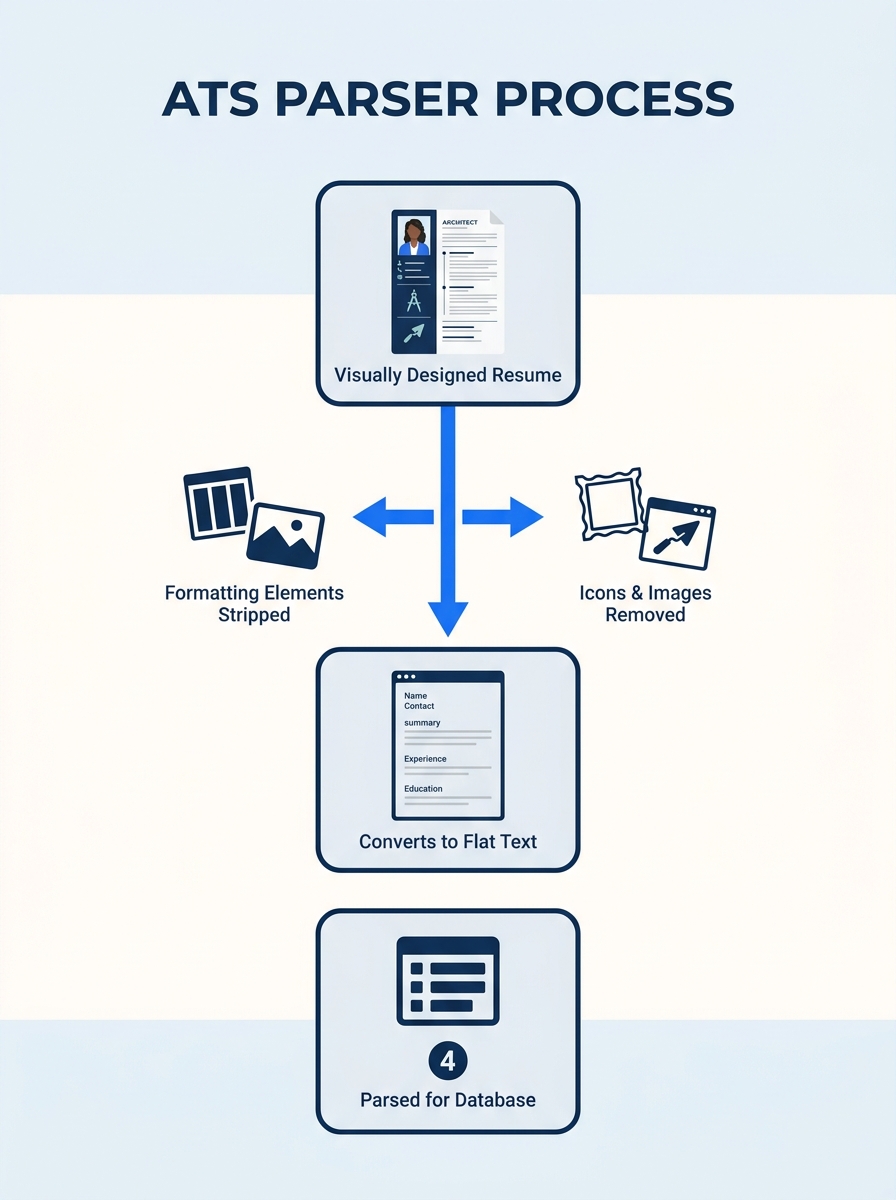
The parsing engine converts your uploaded file into plain text, then segments that text into predefined fields: contact info, work history, education, skills. Every visual element you’ve designed (columns, sidebars, icons, infographics) gets discarded during this conversion. According to VisualCV’s ATS keyword analysis for architecture resumes, the algorithm then looks for exact phrase matches against the job posting, meaning “project management” and “managing projects” register as entirely different terms.
This matters for architects because the profession’s resume conventions work against the parser. Portfolio-style layouts with two-column designs, embedded images, and creative typography are standard in architecture studios. But 99% of Fortune 500 companies run ATS as their first screening layer, and 75% of all recruiters across firm sizes use some form of recruiting technology to filter candidates. Your resume reaches a human reader only after surviving the text-extraction and keyword-scoring steps.
The parser handles standard section headers reliably: “Work Experience,” “Education,” “Skills,” “Certifications.” Custom headers like “Design Philosophy” or “Studio Practice” often get misclassified or ignored entirely. Fonts between 10 and 12 points parse consistently. Anything outside that range introduces extraction errors that can scramble your content into unreadable data, which we’ve covered at length in our look at why standard layouts still fail modern screening systems.
The Keyword Matching Engine and Why Exact Phrasing Matters
Why does a resume full of relevant experience still score poorly? Because the matching algorithm operates on literal string comparison, not semantic understanding. Resume Worded’s 2026 architecture guide describes the recommended approach as a “scan, mirror, prioritize” formula: scan the job description for specific competencies, mirror that exact language in your resume, then place the highest-value terms near the top of the document.
For architect resume ATS optimization, the high-value keyword categories break into four groups:
Design software: AutoCAD, Revit, SketchUp, 3ds Max, Rhino, Grasshopper, Enscape, Adobe InDesign, Photoshop. Each should appear as the exact product name. Writing “Autodesk’s building information modeling tool” instead of “Revit” means the parser misses the match entirely.
Building systems resume keywords: construction documentation, building code compliance, sustainable design, LEED AP, WELL AP, site analysis, zoning analysis, life safety code. These terms appear across the vast majority of architecture job postings and should show up in both your skills section and your project descriptions.
Project management terms: project delivery, client coordination, consultant coordination, construction administration, design development, schematic design, design-build. These signal your role scope beyond pure design work.
Regulatory and standards terms: ADA compliance, IBC, local building codes, energy code compliance, NCARB. Resume Worded’s architect skills guide advises identifying “those that are most relevant to the job you’re applying to” rather than dumping every keyword you can think of into a single block.
The parser doesn’t understand that you’re a talented architect. It understands that the string “Revit” appeared 3 times in your resume and 4 times in the job description, producing a 75% match score for that term.
Building a Project Section the Parser Can Extract
The core challenge with project-based resume structure for architects is that your work doesn’t map cleanly to the employer-title-dates format ATS expects. You might have worked at one firm for 6 years across 14 projects of varying type, scale, and responsibility. The parser wants discrete entries. Your career is continuous and layered.
The solution is a hybrid structure. Keep the standard reverse-chronological employment section with firm name, title, and dates as your primary framework. Then nest project entries beneath each employer as sub-bullets, each following a consistent format: project name, type, square footage or budget, your specific role, tools used, and a quantified outcome.
Here’s what a well-structured project entry looks like:
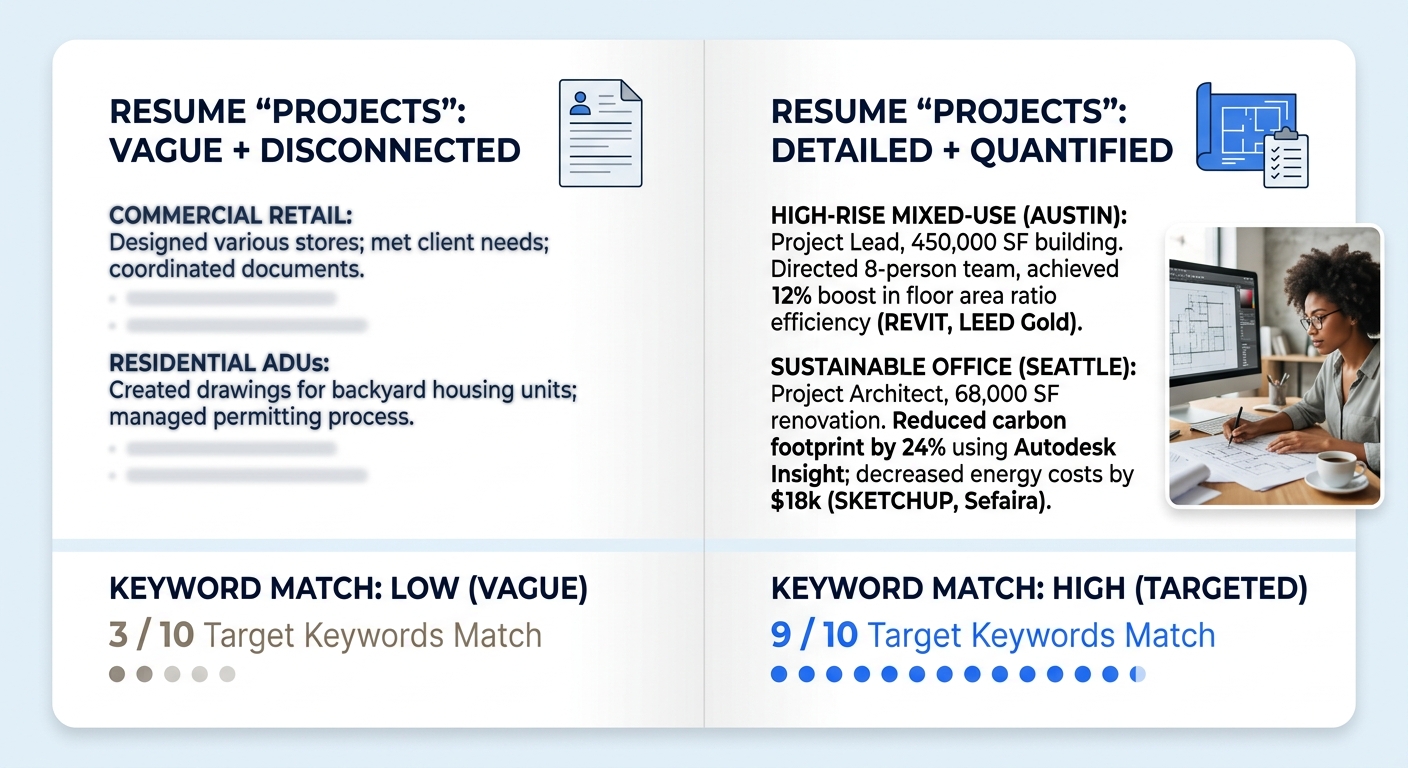
Mixed-Use Development, Portland, OR (220,000 sq ft, $48M budget): Led schematic design through construction documentation for a 12-story mixed-use tower. Created Revit models and coordinated with MEP consultants, reducing RFI volume by 34% compared to the firm’s previous project of similar scale. Achieved LEED Gold certification.
Compare that to the typical architect bullet: “Worked on a mixed-use project in Portland.” The first version gives the parser 9 matchable keyword phrases. The second gives it 1.
Enhancv’s 2026 architect resume guide showcases examples like “developed architectural concepts for commercial spaces with an emphasis on sustainability, cutting energy costs by 20%” and “coordinated with engineers and designers, enhancing project delivery speed by 15% using BIM software.” Resume Worded’s architecture examples recommend including “key details like project type, scope, and specific deliverables” in every project description. These templates demonstrate how quantified project descriptions feed the matching algorithm significantly more data points than generic role descriptions ever will.
Technical Skills Documentation Architecture That Survives Parsing
The skills section on an architect’s resume needs internal organization to maximize both ATS scoring and human readability. Resume Worded’s architectural designer guide recommends grouping skills into labeled categories rather than listing them as a single undifferentiated block. Their suggested structure translates well into a format both parsers and people can read quickly:
| Category | Example Skills | Parser Benefit |
|---|---|---|
| Design Software | AutoCAD, Revit, SketchUp Pro, Rhino, Grasshopper | Exact product-name matches |
| Visualization Tools | Enscape, V-Ray, Lumion, Adobe Creative Suite | Distinguishes rendering from modeling |
| Technical Knowledge | Building code compliance, construction documentation, sustainable design | Captures regulatory keywords |
| BIM and Coordination | Revit MEP coordination, Navisworks, BIM 360 | Matches BIM-specific postings |
| Certifications | LEED AP BD+C, WELL AP, Registered Architect (State, License #) | Credential verification terms |
| Project Delivery | Design-build, IPD, construction administration | Phase-specific terminology |
This categorized approach helps the parser index each skill term correctly and helps the hiring manager (when your resume reaches one) scan your capabilities in under 10 seconds. Teal’s 2026 architectural designer guide emphasizes listing “proficiency in software, project management, and client relations” as separate skill groups rather than jumbling technical and interpersonal competencies together.
Your technical skills documentation architecture should also account for how you describe proficiency levels. Writing “Expert in Revit” gives the parser one keyword match. Writing “Created Revit models, construction documents, and clash detection workflows across 8 commercial projects totaling 1.2M sq ft” gives it five matchable phrases plus a quantified scope indicator. If you’re unsure which terms to prioritize for a given posting, the process mirrors what we’ve explored in auditing AI-generated resume suggestions for authenticity: compare the job description’s exact language against your current resume, then close the gaps term by term.
Tip: Place your licensure details (e.g., “Registered Architect, Texas, License #6890”) in a dedicated section immediately after Education, not buried in a summary paragraph. ATS systems index credential sections separately, and hiring managers at architecture firms scan for licensure status within the first few seconds of review.
The Quantification Layer That Separates Callbacks from Silence
Raw keyword presence gets your resume past the initial filter. Quantified achievements determine whether you land in the “interview” pile once a hiring manager reads the document. This two-stage gatekeeping process means your resume needs to satisfy two different audiences with the same content.
Architects often struggle with quantification because design outcomes feel qualitative. But research from multiple resume guides shows consistent patterns in what converts callbacks. Beamjobs’ architecture resume examples demonstrate how integrating tools like “ArcGIS, Autodesk Civil 3D” into outcome statements shows both the tool and its impact in one sentence. Enhancv’s guide highlights bullets like “cutting energy costs by 20%” and “enhancing project delivery speed by 15%” as effective structures that serve both the parser and the human reader.
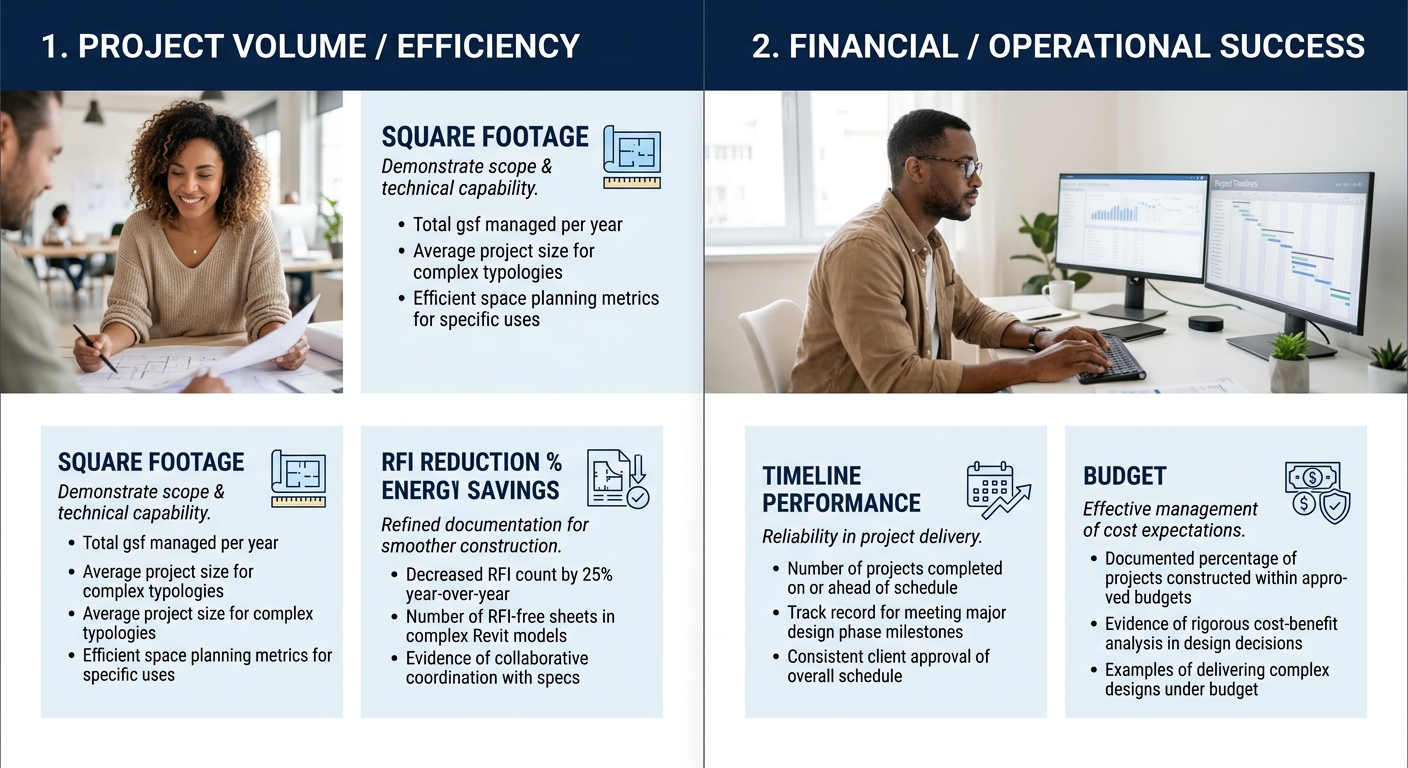
Quantifiable metrics architects can pull from their actual project work include: square footage designed or managed, construction budget overseen, percentage reduction in RFIs or change orders, energy performance improvements, number of consultant teams coordinated, permitting timelines met or beaten, and cost savings from material specification changes. A bullet stating “optimized HVAC zoning layout using Revit, reducing material waste by 12%” gives the parser both a software keyword and a measurable result in one line.
The metrics framework for non-technical roles applies here with some adaptation. Architecture sits in an unusual space where the work is deeply technical but the outcomes are often measured in client satisfaction, timeline adherence, and budget performance. If you can attach a number to a project outcome, do it. If you can attach a dollar figure, even better. A $48M project budget tells a hiring manager more about your responsibility level than three paragraphs of description.
Where This Approach Breaks Down
The project-based resume structure optimized for ATS has real limitations that are worth understanding before you rebuild your entire document around keyword density.
The first limitation is that this process creates a document fundamentally different from what the architecture profession traditionally values. Your resume becomes a keyword-dense, metric-heavy text file while your portfolio showcases spatial thinking, materiality, and design vision. These two documents serve different purposes, and as we’ve explored in the discussion of why resume bullets can’t replace visual evidence for architects, no amount of ATS optimization substitutes for a strong portfolio link placed prominently in your header.
The second limitation is firm size. Small architecture studios with 5 to 15 people rarely use ATS software at all. Your carefully optimized resume goes directly to a principal who cares more about your design sensibility than your keyword density. For applications to firms under 50 employees, a slightly more narrative approach with fewer keyword repetitions often reads better to the human who will be your only reviewer.
The third limitation is keyword saturation. When 91% of employers screen through ATS and candidates know it, everyone optimizes for the same terms. Your resume matches the same keywords as 200 other applicants for the same project architect role. The differentiator shifts from keyword presence to the specificity and scale of your project descriptions. Writing “Led construction documentation for a 340,000 sq ft healthcare facility achieving FGI compliance” separates you from “Prepared construction documents for various project types” even when both resumes contain identical keyword sets.
And the mechanism assumes a static job description. Architecture postings at the same firm vary significantly between a healthcare-focused project architect role and a residential design position. Each application demands different keyword emphasis, different ordering of your project entries, and different skills highlighted at the top. The one-click job matching trap applies with particular force to architects: a single resume optimized for “architecture” in general will score lower than a version tailored to the specific project type, delivery method, and software stack named in each individual posting.
The ATS is a filter, not a judge of architectural talent. Getting through it is necessary at large firms and irrelevant at small ones. The mechanism works when you understand both what it can see (keywords, section headers, chronological data) and what it throws away (your design eye, your spatial intelligence, everything that actually made you become an architect in the first place). Your resume’s job is to survive the algorithm. Your portfolio’s job is to win the interview.