

 4.9
4.9 4.5
4.5Rachel Wells’ March 2026 analysis in Forbes surfaced a number that should reframe how you think about certifications and courses on your resume: 85% of hiring managers actively want to see a dedicated skills section. The finding sounds encouraging for anyone who’s invested time in upskilling. But Wells herself added a critical caveat that most job seekers gloss over: “Keywords only work when they have real meaning attached.” The gap between listing a certification and proving its value is where most continuous learning positioning falls apart on a resume.
This article dissects that gap through one specific lens: how a mid-career professional’s upskilling credentials typically appear on a resume, why that default format fails both human reviewers and ATS systems, and what the rewrite looks like when you anchor every credential to measurable work.
The 85% Finding and Its Uncomfortable Footnote
The Forbes data point lands well as a headline. Eighty-five percent of hiring managers want your skills section. But the same analysis revealed that the way most people populate that section actively hurts them. Wells described the pattern bluntly: listing keywords without evidence produces a resume that reads like a tag cloud, not a professional story.
This is the trap continuous learners fall into most often. You complete a Google Data Analytics Certificate, an AWS Cloud Practitioner exam, a Coursera specialization in project management. You add them to your resume in a tidy list under “Certifications” or “Professional Development.” And then nothing happens.
The reason nothing happens is that hiring managers who see a standalone certification line—say, “AWS Cloud Practitioner, Amazon Web Services, 2025″—can’t answer the question they actually care about: did this person apply what they learned, and did it produce results? That question goes unanswered on the vast majority of resumes that include recent credentials.
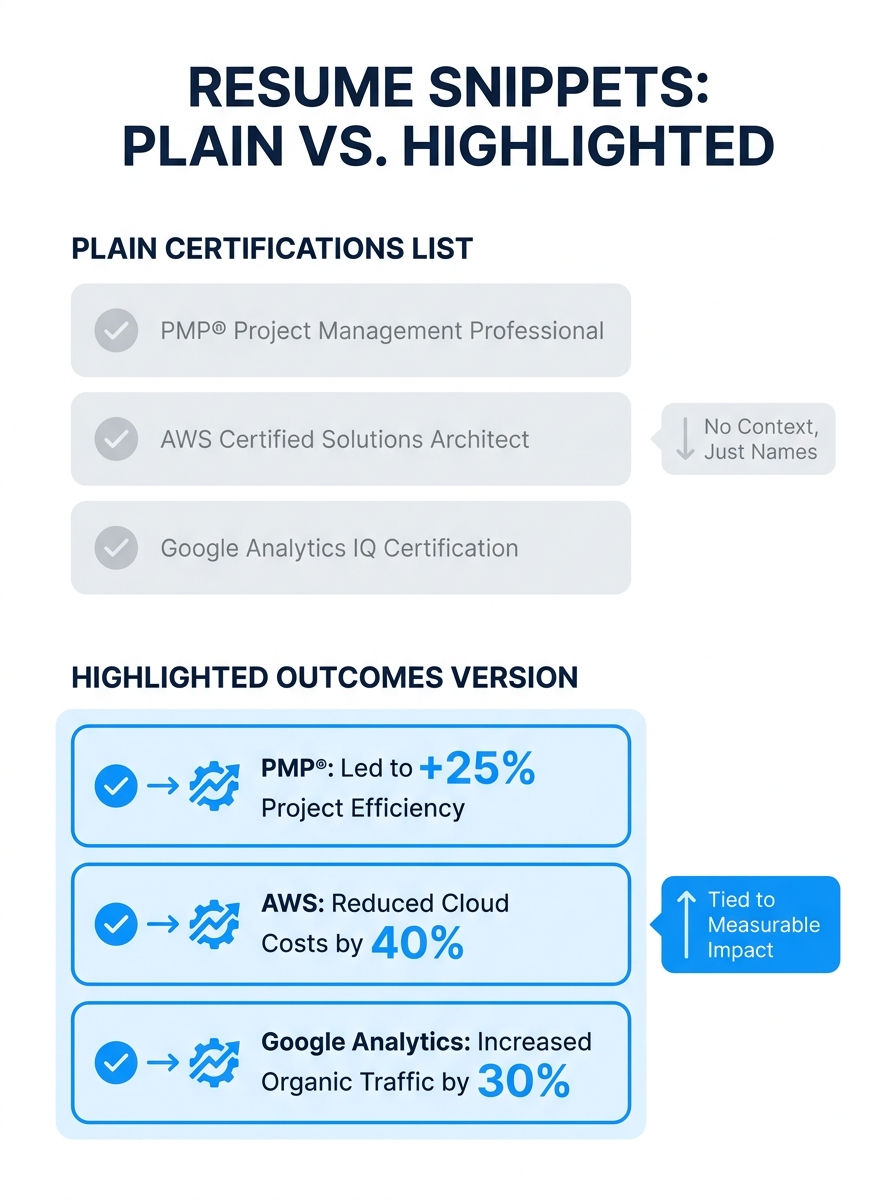
And as we’ve covered in our breakdown of how ATS and human screening now work in parallel, both algorithmic filters and human reviewers penalize isolated keywords that don’t appear in context. A certification name sitting alone in a list may match a keyword filter, but it won’t survive the 11-second human scan that follows.
A Credential List That Went Nowhere
Consider a real pattern we see constantly in resume reviews. A marketing professional with seven years of experience completes three courses over 18 months: HubSpot Inbound Marketing Certification, Google Analytics 4 Certification, and a LinkedIn Learning path on marketing automation. Their resume’s education section looks like this:
Professional Development
- HubSpot Inbound Marketing Certification, HubSpot Academy, 2025
- Google Analytics 4 Certification, Google, 2025
- Marketing Automation Specialization, LinkedIn Learning, 2024
Clean formatting. Accurate dates. Completely inert. This layout tells a hiring manager that you completed coursework, and nothing about what changed in your work as a result. The skill development framing here is passive by default: you received credentials rather than demonstrating capability.
Harvard Business School’s career guidance makes the prioritization clear: include only certifications and credentials that align with your career goals, and recognize that irrelevant entries dilute impact. But alignment alone isn’t enough. Even perfectly relevant credentials fail when they sit in a list format with no connective tissue to your experience section.
This is where the real audit begins. The question you need to answer for each credential on your resume: can you point to a specific bullet in your experience section where this learning produced a documented outcome?
If the answer is no, you have two options. Either you add that bullet (because the outcome exists and you haven’t written it yet), or you demote the credential to a supporting detail rather than a standalone line item.
The Same Certification, Rewritten Three Ways
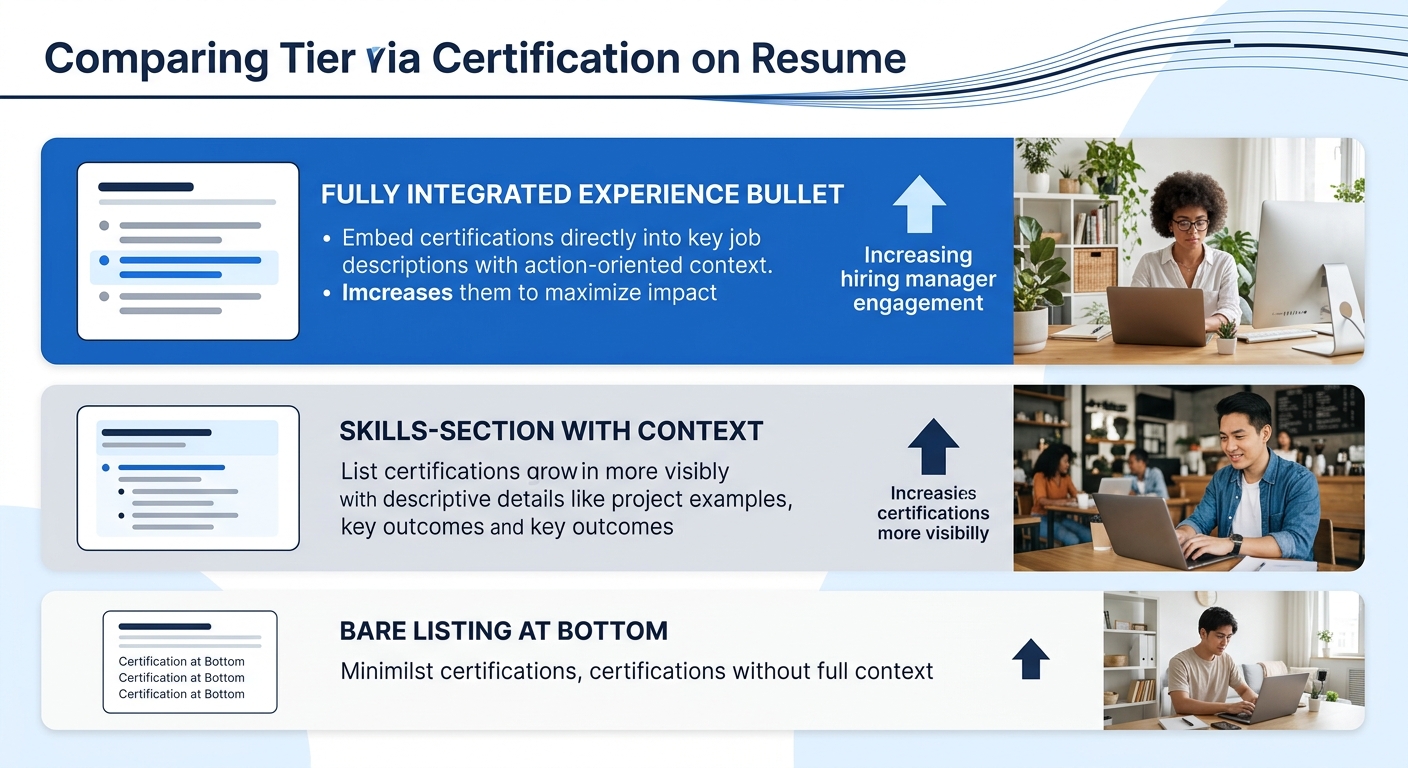
Let’s take the Google Analytics 4 Certification from our example and walk through three versions of how it can appear on a resume. Each version represents a different level of upskilling resume language sophistication.
Version 1: The bare listing
Under Professional Development: “Google Analytics 4 Certification, Google, 2025”
This is where most resumes stop. It confirms you passed an exam. It occupies space. It does almost nothing for your candidacy because it provides zero evidence of application.
Version 2: The skills-section mention with context
Under Skills: “Google Analytics 4 (Certified), campaign attribution, funnel analysis, audience segmentation”
Better. You’ve added specific competencies associated with the cert, which gives both ATS systems and human readers more to work with. The upskilling resume language here connects a credential to actual skill areas in ways that improve keyword matching against job descriptions mentioning those specific GA4 capabilities.
Version 3: The experience-integrated bullet
Under your most recent role in the Experience section: “Restructured campaign attribution model using GA4’s data-driven attribution after completing Google certification, reducing cost-per-acquisition by 22% across paid social channels within first quarter of implementation.”
This version does three things at once. It names the credential, demonstrates direct application, and quantifies the result. A hiring manager reading this bullet understands that you learned something, used it, and produced a measurable outcome for the business.
The question you need to answer for each credential: can you point to a specific bullet in your experience section where this learning produced a documented outcome?
The difference between Version 1 and Version 3 is the difference between a resume that confirms you’re a learner and one that proves you’re effective. Both signals matter, but only the second one consistently generates interview callbacks. ResumeSpice’s guidance on certifications resume placement reinforces this hierarchy: include only current certifications, mark renewal dates for time-limited credentials, and curate achievements based on the target role. That curation step is where most people skip ahead and dump everything onto the page.
Where on the Page These Credentials Land
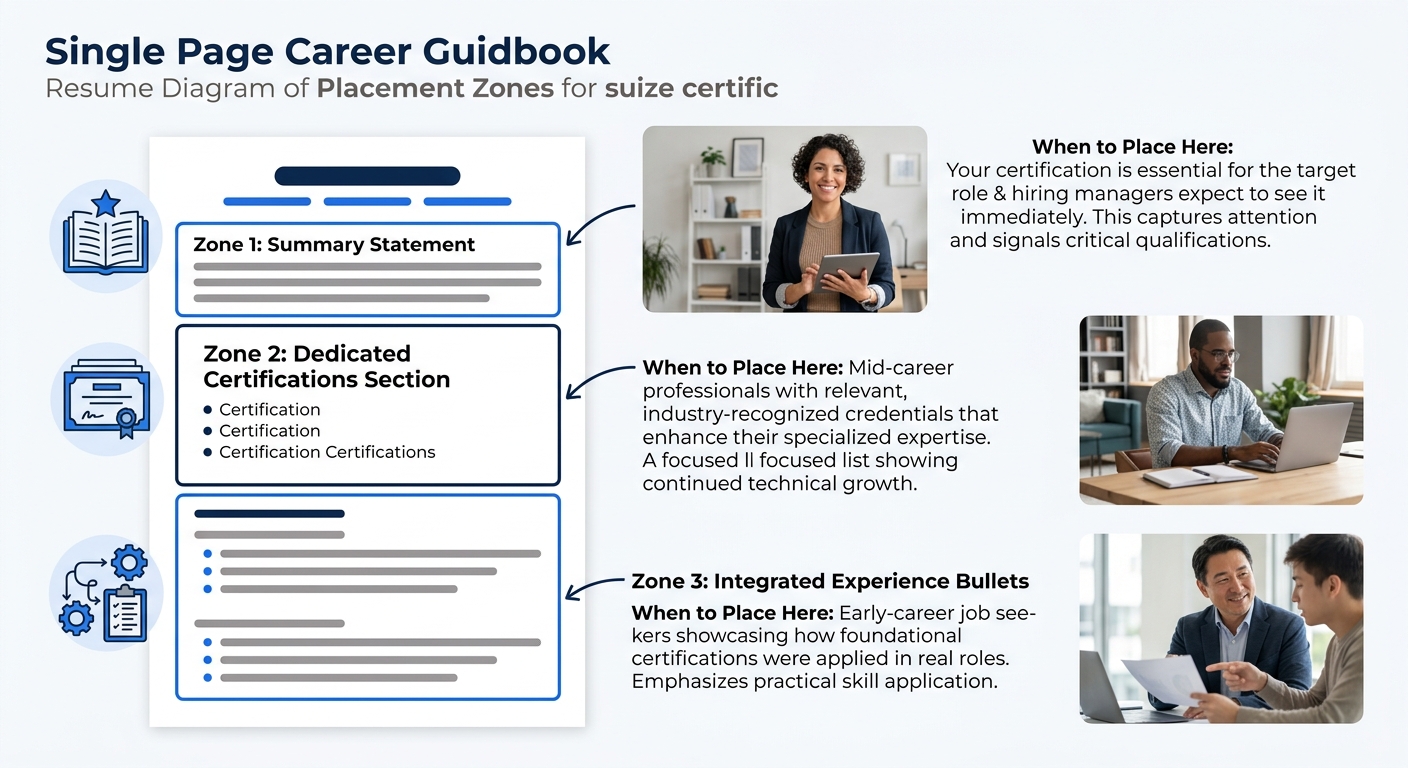
Certifications resume placement depends on your career stage and how central the credential is to the role you’re targeting. Enhancv’s guidance provides a useful heuristic: place education at the top for students and early-career professionals, below experience for everyone else. Resume.org extends this with three placement tiers:
- In your summary statement, if the credential is a hard requirement for the role (e.g., a CPA listing for an accounting position, a PMP for a project manager). This works when the certification appears as a must-have in the job posting and you want it visible in the first three lines.
- In a dedicated “Licenses and Certifications” section, when you have several credentials that collectively signal your professional development arc. This is where your HubSpot, GA4, and LinkedIn Learning certs would live if you’re applying to a marketing role that values breadth.
- Integrated into your experience bullets, as we showed in Version 3 above. This is where the high-impact certifications belong, the ones where you can directly tie learning to work output.
The strongest resumes use options 2 and 3 simultaneously. Your dedicated certifications section serves as a scannable reference list (good for ATS parsing and for recruiters who ctrl+F specific credential names). Your experience bullets then provide the evidence layer that proves application.
Tip: If you have more than five certifications or courses, filter ruthlessly. For each one, ask: does this credential appear anywhere in the job description or in the required/preferred qualifications? If it doesn’t, and if you can’t tie it to a quantified outcome, leave it off this version of your resume. You can always add it back for a different application.
And don’t forget: adaptability employer messaging comes through more clearly when your resume shows you learned something in direct response to a workplace challenge, not because you were browsing Coursera on a slow weekend. Framing matters enormously here. “Completed Python fundamentals course” reads differently from “Identified recurring manual data-cleaning bottleneck, completed Python automation training, and built scripts that reduced weekly processing time from 6 hours to 45 minutes.” The second version demonstrates the kind of adaptability that TopResume recommends weaving into your summary, experience, and skills sections alike.
If you’re finding that your bullets generally lack the specificity to anchor credentials effectively, our walkthrough on converting vague accomplishments into measurable outcomes covers the mechanics of that rewrite process in detail. The continuous learning audit and the specificity audit overlap significantly because they’re both about proving impact rather than listing activity.
What the 85% Are Really Screening For
The Forbes finding about skills sections tells us something important about how hiring managers read resumes now. They aren’t scanning for a laundry list of things you’ve studied. They’re looking for signal: evidence that you can identify a gap in your own capabilities, close it through deliberate learning, and then apply the result in a way that moved a metric or solved a problem.
That signal is what separates a resume that mentions continuous learning from a resume that demonstrates it. The distinction matters more now than it did even two years ago, because the volume of credentials flooding the market has made bare certification listings functionally meaningless as differentiators. When every candidate in the stack has a Google cert, having a Google cert tells a hiring manager nothing. Showing what you did with it tells them everything they need to know about how you’d perform in the role.
Your audit process should be straightforward. Pull up your current resume. Highlight every certification, course, or professional development entry. For each one, trace a line to a specific experience bullet that shows application and results. Where you can’t draw that line, you’ve found the weak point, and you either need to write that missing bullet or reconsider whether the credential earns its place on this version of your resume. In a market where generic resumes are becoming obsolete under competitive screening pressure, every line on the page needs to carry weight.
The 85% of hiring managers who want your skills section are asking a question with their attention: show me what you can do, and show me how you proved it to yourself before you brought it here. Every credential on your resume should have an answer ready for that question, written into the experience section where it does the most good.