


 4.9
4.9 4.5
4.5Challenger, Gray & Christmas counted nearly 50,000 AI-linked job cuts announced across U.S. companies in 2026, representing about 17% of all layoffs tracked this year. For displaced tech workers weighing a $300 resume rewrite against a $2,000+ career coaching engagement, the career coach ROI data increasingly favors coaching, but which service you need depends on where you are in the recovery timeline.
When the Cuts Arrived in Clusters
Amazon announced 16,000 job eliminations early in 2026. Meta followed with 8,000. Intuit cut 3,000 employees, roughly 17% of its workforce. Block slashed approximately 4,000 positions, about half its headcount. These weren’t isolated incidents spread across months. They landed in overlapping waves, flooding the job market with tens of thousands of qualified engineers, product managers, and data scientists all looking for work at the same time.
Goldman Sachs research quantified the downstream effect: AI adoption has reduced monthly U.S. payroll growth by roughly 16,000 jobs over the past year, and the squeeze hits junior and entry-level roles hardest because those tasks are easiest to automate. The decline in entry-level postings has created a bottleneck where even experienced professionals are competing downward for roles they’d normally skip.
This was the environment in which thousands of displaced tech workers had to make their first spending decision: fix the resume, or invest in something broader?

The Resume Service Gold Rush
Within days of each layoff announcement, resume writing services reported surges in orders from tech professionals. The logic felt airtight: update the document, optimize for ATS keywords, start applying. A typical resume rewrite runs $300 to $800 for mid-career professionals and $1,000 to $1,500 for executive-level rewrites.
And for a specific subset of job seekers, this instinct was correct. As one user on r/jobsearchhacks explained: “One thing I do think can be worth it: resume services, if you’re confident in your experience and just need better positioning. I used Resumeble, and it worked well for me. I’ve been in my role for 11 months now.”
The key phrase there is “confident in your experience.” The resume service worked because this person already knew their story. They knew what roles to target, what skills to emphasize, and how to talk about their career arc. They needed a better document, not a better strategy.
But most people displaced in mass layoffs don’t have that clarity. They’ve been inside one company, or one narrow industry niche, for years. The ground beneath them shifted overnight. For these workers, a polished resume became a beautifully formatted version of the wrong pitch.
Why the Documents Stopped Converting
Kyle Elliott, a tech career coach, identified the core failure pattern: he can immediately spot resumes written by AI or generic services because they lack role-specific keywords. A systems engineer’s resume that never contains the phrase “systems engineer” is, in Elliott’s words, “generic slop” that fails to differentiate candidates in a saturated market.
The saturation was the crucial variable. When 8,000 people leave Meta in the same quarter, hiring managers at competing companies receive hundreds of applications from candidates with nearly identical credentials. A well-formatted resume that reads like every other Meta alum’s resume doesn’t solve the differentiation problem. You’re now one of 200 polished, keyword-optimized, structurally similar documents in a single applicant pool.
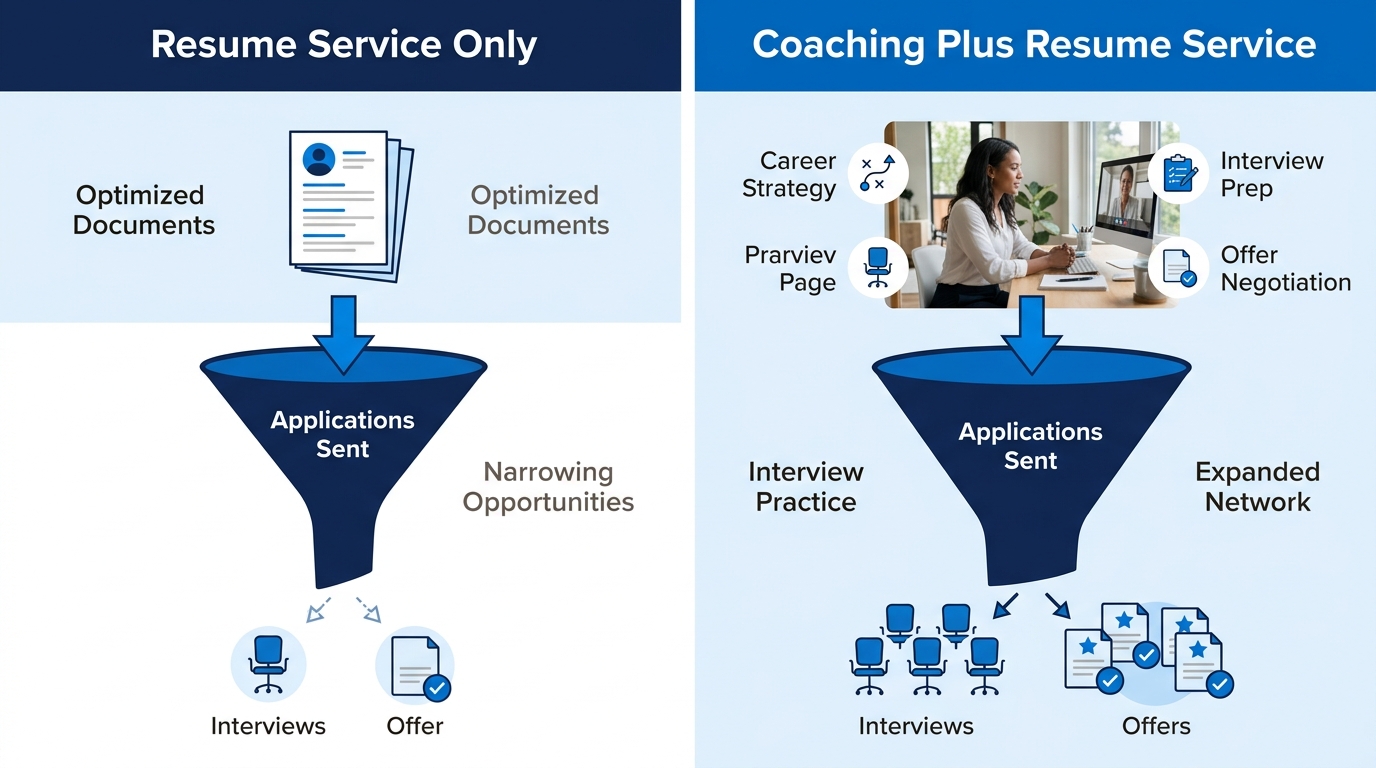
Career coaches who work with displaced engineers noticed this pattern playing out across their client bases. The resume writing service vs coaching question stopped being theoretical and became measurable: clients who invested only in resume rewrites were reporting lower callback rates than those who paired the rewrite with strategic positioning work.
The International Association of Career Coaches (IACC) draws the line clearly: “While a résumé writer will help you land an interview, a career coach more-or-less helps with the rest of the process.” In a normal market, landing the interview is the hard part. In a mass-layoff market where everyone has strong credentials, the interview itself becomes the bottleneck, and no resume service prepares you for that.
The Coaching Pivot, Month by Month
By February and March 2026, displaced workers who had started with resume-only investments began seeking coaching. The pattern was consistent: they’d spent $400 to $800 on a professional rewrite, sent 50 to 100 applications, gotten fewer than five callbacks, and realized something fundamental was off.
Tessa White, founder of The Job Doctor, described the environment these workers were entering as a “‘Hunger Games’-like competition” where thousands of laid-off workers compete for a shrinking number of openings. Her coaching approach focused on shifting clients from what she calls a “scarcity mindset” into strategic targeting, defining must-haves and dealbreakers before sending a single application.
Career coaching for tech professionals typically costs $150 to $350 per session, with most coaches recommending packages of 6 to 12 sessions. A full engagement runs $1,500 to $4,000. The scope goes well beyond document preparation: LinkedIn profile strategy, narrative alignment between resume and interview answers, mock interviews tailored to specific companies, and salary negotiation based on real market data.
One senior sales engineer who worked with BetterCareer, a coaching firm focused on tech sales professionals, put the return bluntly: “I’ve completely blown out the ROI on what it cost me. So in my mind, it’s a no brainer.” Another BetterCareer client reported getting interviews with seven companies and receiving a job offer within six weeks of starting the coaching program.
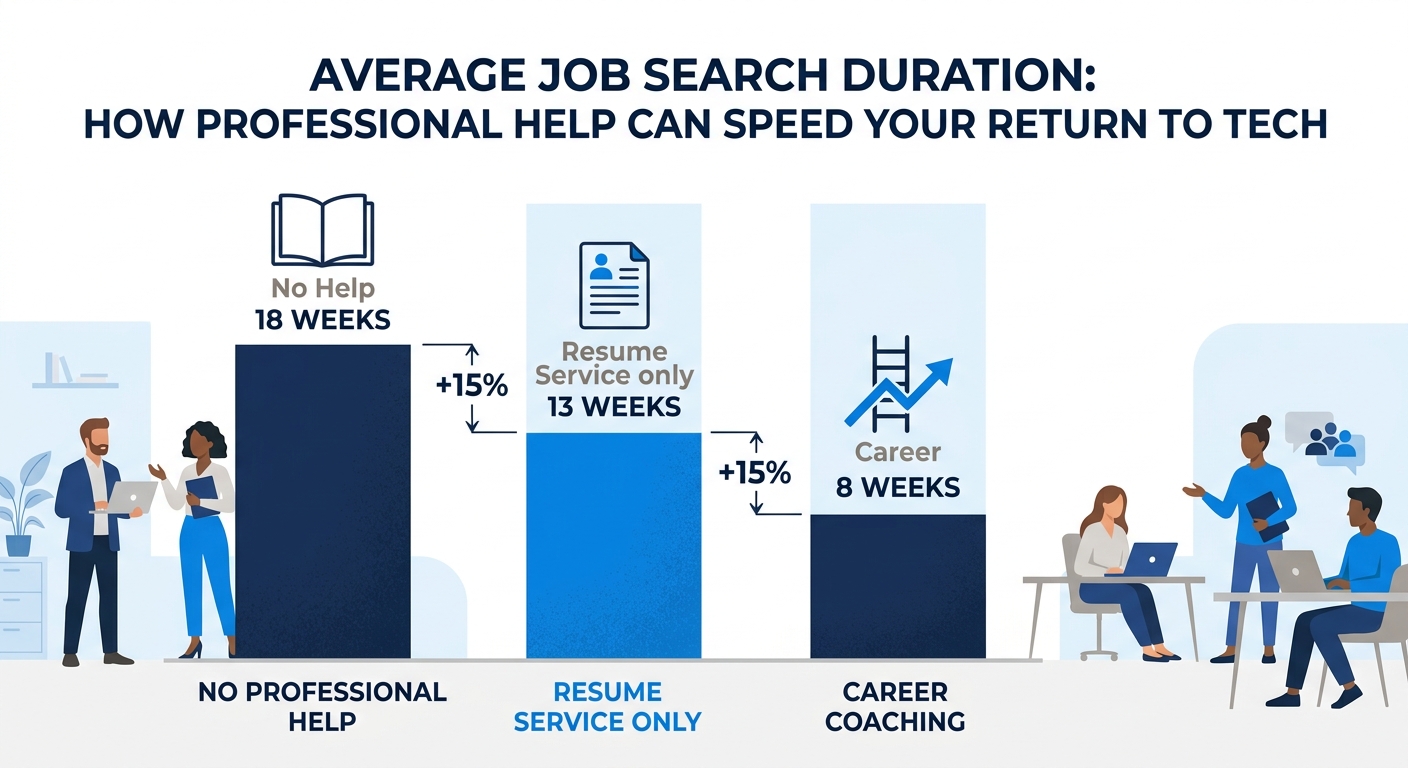
That six-week timeline matters. If a coaching engagement costs $3,000 and shortens your job search by even two months, you’re recovering $15,000 to $30,000 in lost salary. The career transition investment math favors coaching whenever the search would otherwise drag past the three-month mark.
How Coaching Changes the Search Itself
Forbes career expert Sho Dewan outlined the interview approach that separates coached candidates from uncoached ones: “Talk about the skills you gained during the employment, the challenges you overcame, and the professional growth you’ve experienced during your previous role, and then transition the conversation from the layoff to why and how your skills align with the new role.”
That reframing is what coaches drill into clients over multiple sessions. An uncoached candidate often stumbles over the layoff question, getting defensive or vague. A coached candidate treats it as a transition point in a narrative they’ve rehearsed and refined. The difference shows up in offer rates, and it’s the piece that no resume service can provide.
For workers considering a full career pivot (enterprise software to healthtech, for example), coaching becomes even more important. Coaches help restructure resumes to highlight transferable skills and quantified achievements that translate across industries, and they run mock interviews using the vocabulary and evaluation criteria specific to the target sector.
In a mass-layoff market where everyone has strong credentials, the interview itself becomes the bottleneck, and no resume service prepares you for that.
The Two Investments Compared Side by Side
| Factor | Resume Writing Service | Career Coaching |
|---|---|---|
| Typical cost | $300–$1,500 | $1,500–$4,000 |
| Timeline to deliverable | 1–2 weeks | 6–12 weeks |
| Primary output | Polished, ATS-optimized resume | Career strategy, interview prep, salary negotiation, resume direction |
| Best for | Professionals who already know their target role and need better packaging | Professionals navigating layoffs, career pivots, or stalled searches |
| Callback improvement | Moderate (depends heavily on market saturation) | Higher (addresses positioning, differentiation, and interview performance) |
| Ongoing support | Usually 1–2 revision rounds | Multiple sessions with feedback loops and accountability |
| Post-layoff fit | Strong when the candidate has a clear narrative | Strong when the candidate needs to build or reframe the narrative |
The career counselor comparison here reveals a tech layoff recovery strategy that many displaced workers arrive at through trial and error: start with the resume service if you already know your target, but invest in coaching if you’re unclear on positioning, struggling with callbacks after 30+ applications, or pivoting industries entirely.
Tip: If you’ve sent more than 40 applications with a professionally rewritten resume and received fewer than 3 interview invitations, the bottleneck is almost certainly strategic, not formatting. That’s the signal to explore coaching.
Understanding the differences between AI resume tools and human career coaches adds another layer to this decision. Automated tools can optimize a document quickly, but they can’t tell you that your target role is overcrowded or that your experience maps better to an adjacent function you haven’t considered.
Where the Data Lands Today
The tech layoff cycle of 2026 has produced a natural experiment in career transition investment. Tens of thousands of similarly credentialed professionals entered the job market within weeks of each other, and they split roughly into three groups: those who handled everything themselves, those who bought resume services, and those who engaged coaches.
Professionals who found our guides on post-layoff resume rebuilding and coaching early tended to make more informed spending decisions. But the broader pattern across the industry is consistent. Resume services solve a document problem. Career coaching solves a strategy problem. When 50,000 AI-linked cuts flood the market with qualified candidates in a single year, strategy is what determines whether your search takes six weeks or six months.
The workers landing offers fastest are the ones who can articulate their unique value, navigate the layoff conversation without flinching, and target roles with precision rather than volume. That combination of skills is the product of coaching. And at ResumeWriting.net, the data we’ve tracked through this cycle confirms what career professionals have argued for years: the resume is the vehicle, but knowing where to drive it is what actually moves the needle.