
 4.9
4.9 4.5
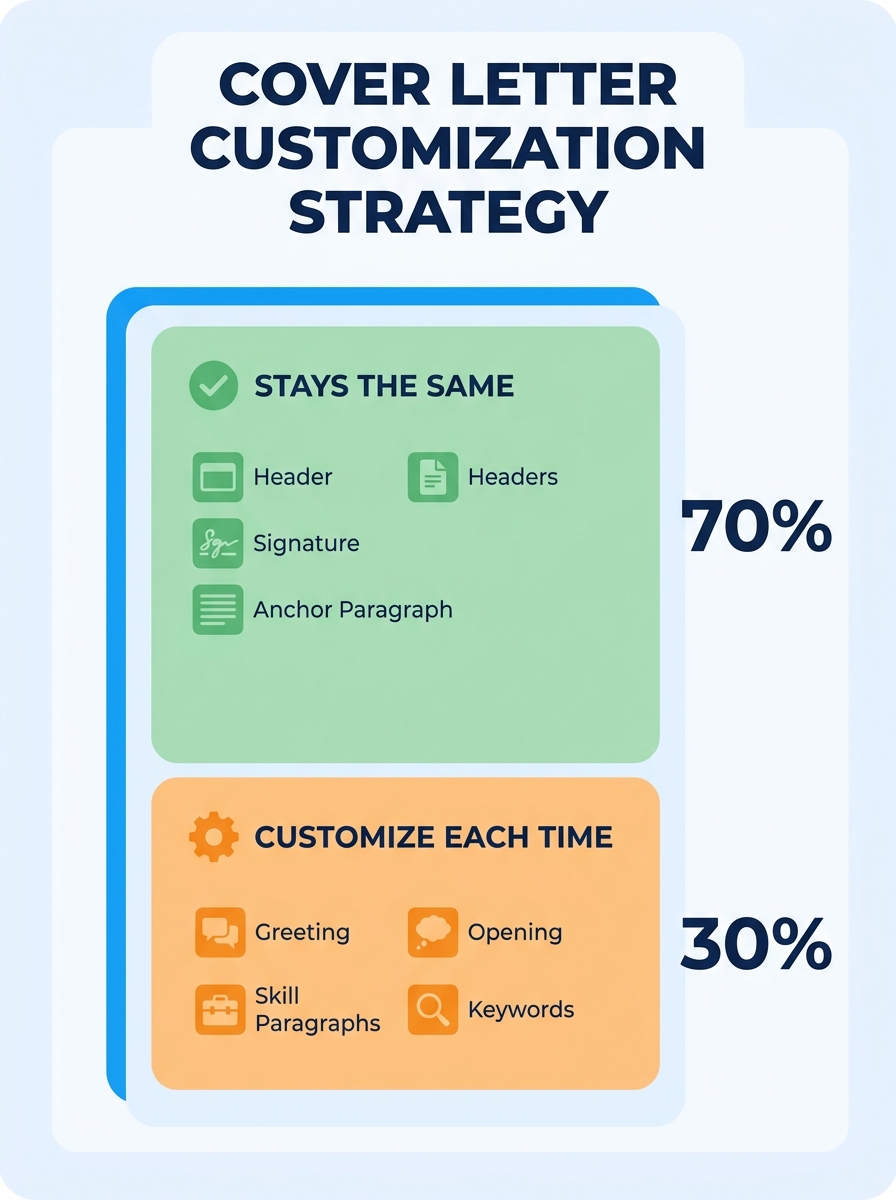
4.5Forty-five percent of job applicants send the same cover letter to every opening, and 76% of hiring managers say they reject those generic submissions on sight. A reusable “base draft” where roughly 70% of your letter stays fixed and 30% gets tailored per role eliminates the blank-page problem while still reading as custom-written.
TL;DR: Build one strong base cover letter with modular skill paragraphs, then swap three elements for each application: the opening line, 2-3 keyword-matched body paragraphs, and a company-specific closing. This cuts application time from 60+ minutes to 15-20 while passing both AI screening and human review.
Why Identical Cover Letters Get Rejected
The rejection rate for generic cover letters is steep because hiring managers and AI screening systems are both tuned to spot them. Robert Half career advisors recommend you address the cover letter to the person hiring for the position instead of using “Dear Employer,” and 94% of hiring managers confirm that cover letters influence their interview decisions. Meanwhile, 83% of companies now run applications through AI screening before a human reviews them, and those systems flag letters that lack keywords from the specific job posting.
The numbers stack against generic applicants on every side. Seventy-two percent of hiring managers expect a cover letter even when the posting lists it as optional, yet 80% of those same managers say they can identify generic AI-generated content. Fifty-seven percent consider it a dealbreaker. So you need a letter that’s personalized enough for human readers and keyword-optimized for algorithms simultaneously. Writing each one from zero isn’t sustainable when you’re applying to 10-20 jobs per week.
The Base Draft Method
A “base draft” is a reusable version of your cover letter with flexible language, saved examples, and a strong structure, as Enhancv’s tailoring guide describes it. You personalize it in a few minutes for each job rather than staring at a blank document. The concept works because every cover letter shares the same bones: a header with your contact information, a greeting, 3-4 body paragraphs, and a closing signature. Columbia Career Education recommends keeping the letter to one page, about three or four paragraphs, and single-spaced.
Here’s what stays the same across applications:
- Your contact information block and formatting
- Your signature and closing line structure
- One “anchor” paragraph about your strongest, most transferable achievement
- Your general professional narrative and tone
And here’s what changes every time:
- The greeting (hiring manager’s name, always)
- The opening 1-3 sentences connecting you to this specific company
- The skill paragraphs you select from your modular library
- 3-4 keywords pulled directly from the job description
Think of the base draft like a well-organized closet. The structure is permanent. The outfits you pull from it change depending on the occasion.
Building Your Modular Paragraph Library
The real time savings come from preparing 5-8 skill paragraphs in advance, each focused on a different competency. When a job description emphasizes project management, you plug in your project management paragraph. When it emphasizes client relationships, you swap in that one instead.
Each modular paragraph should follow a consistent internal pattern: name the skill, describe a specific situation where you applied it, and include one quantifiable result. If you’ve been working through a metrics framework for non-technical roles, you already have the numbers you need for this.
For example, if you’re a marketing manager, your paragraph library might include separate blocks for:
- Campaign analytics with a specific revenue or conversion figure
- Team leadership with headcount managed and a project outcome
- Budget management with the dollar figure you oversaw
- Cross-functional collaboration with the departments involved and the result
- Content strategy with traffic, engagement, or lead generation numbers
Each paragraph should run 3-5 sentences. That keeps your total letter in the 300-400 word range that hiring managers prefer. Seventy percent of them favor letters that are half a page or shorter, and recruiters spend 60% more time reviewing personalized letters compared to generic ones. Length discipline matters as much as content quality.
Three Customization Zones That Actually Matter
When you sit down to tailor your base draft for a specific role, focus your editing energy on three zones. Everything else can stay untouched.
Zone 1: The Opening Line
Your first sentence determines whether the hiring manager keeps reading. The Interview Guys describe their approach as the “Hiring Manager Research Method”, focused on creating deeply personalized cover letters that forge genuine connections with decision-makers. The practical version: spend 3 minutes on LinkedIn finding the hiring manager’s name and one recent company development, then write an opening sentence that references both.
Generic: “I am writing to apply for the Marketing Manager position at your company.”
Tailored: “Your team’s recent rebrand of the Northwind product line caught my attention, and I’d love to bring my experience scaling B2B campaigns to the Marketing Manager role under Jordan Kim’s leadership.”
The second version takes 90 seconds longer to write and signals that you’ve done actual research. If you’re also reworking your resume for each role, the keyword research you’ve already done through a job-match keyword alignment process feeds directly into your cover letter opening.
Zone 2: The Skill Paragraphs
Pull 2-3 paragraphs from your modular library that match the job description’s top requirements. The order matters: lead with the competency the posting mentions first or most often. If the job description uses specific phrases like “cross-functional stakeholder management” or “pipeline forecasting,” mirror those exact terms in your paragraphs. ATS systems match on precise language, and human readers recognize their own vocabulary reflected back at them.
Zone 3: The Closing Hook
End with a sentence that ties back to the specific company. Don’t close with “I look forward to hearing from you” — that’s the written equivalent of elevator music. Instead, reference a specific initiative, value, or challenge the company faces and explain what you’d contribute to it. This is also the right place to mention a mutual connection if you have one.
Where AI Tools Help and Where They Backfire
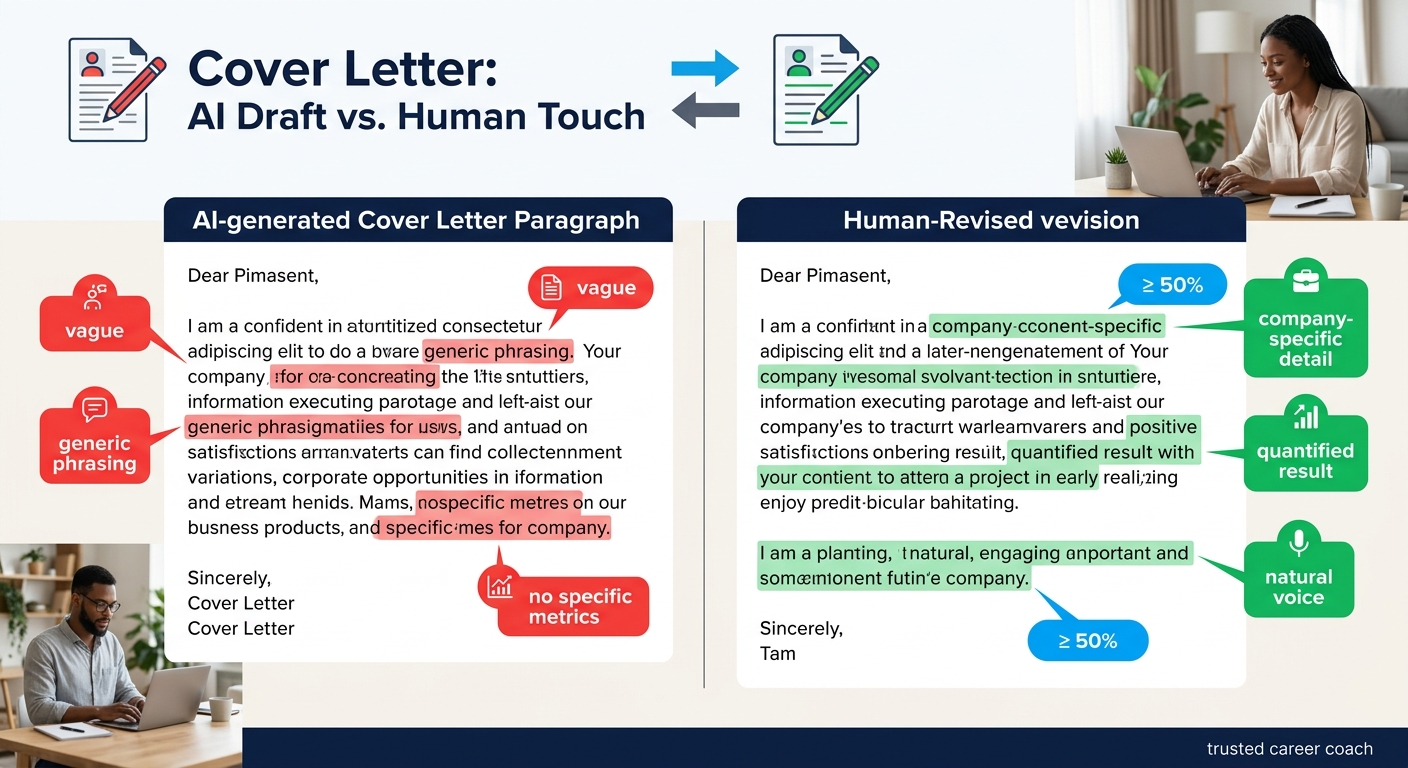
AI cover letter generators from Microsoft Word, Canva, and dozens of standalone tools can produce a structurally sound draft in seconds. The problem is that hiring managers have gotten fast at spotting AI-generated text, and 57% treat it as a disqualifying signal. The output reads clean, but it reads the same kind of clean as everyone else’s output.
The practical approach: use AI for structure and keyword identification, then rewrite the language yourself. Feed the job description into an AI tool and ask it to identify the 5 most important skills the posting requires. Use that list to choose which modular paragraphs to plug into your base draft. But write the connecting tissue (the opening line, the transitions between paragraphs, the closing hook) in your own voice.
If you’ve been auditing AI suggestions for authenticity on your resume, apply the same critical eye to cover letter output. AI is excellent at identifying what to say. It’s mediocre at sounding like a specific human being when it says it. Your voice, your specific examples, and your genuine knowledge of the company are what separate a tailored cover letter from a templated one that happens to have the right keywords sprinkled in.
AI is excellent at identifying what to say. It’s mediocre at sounding like a specific human being when it says it.
And if you’re weighing whether to invest in professional career coaching versus a resume service, consider that a good coach will help you build this entire modular system once (base draft, paragraph library, customization workflow) so you can run it independently for dozens of applications afterward.
The 15-Minute Per-Application Workflow
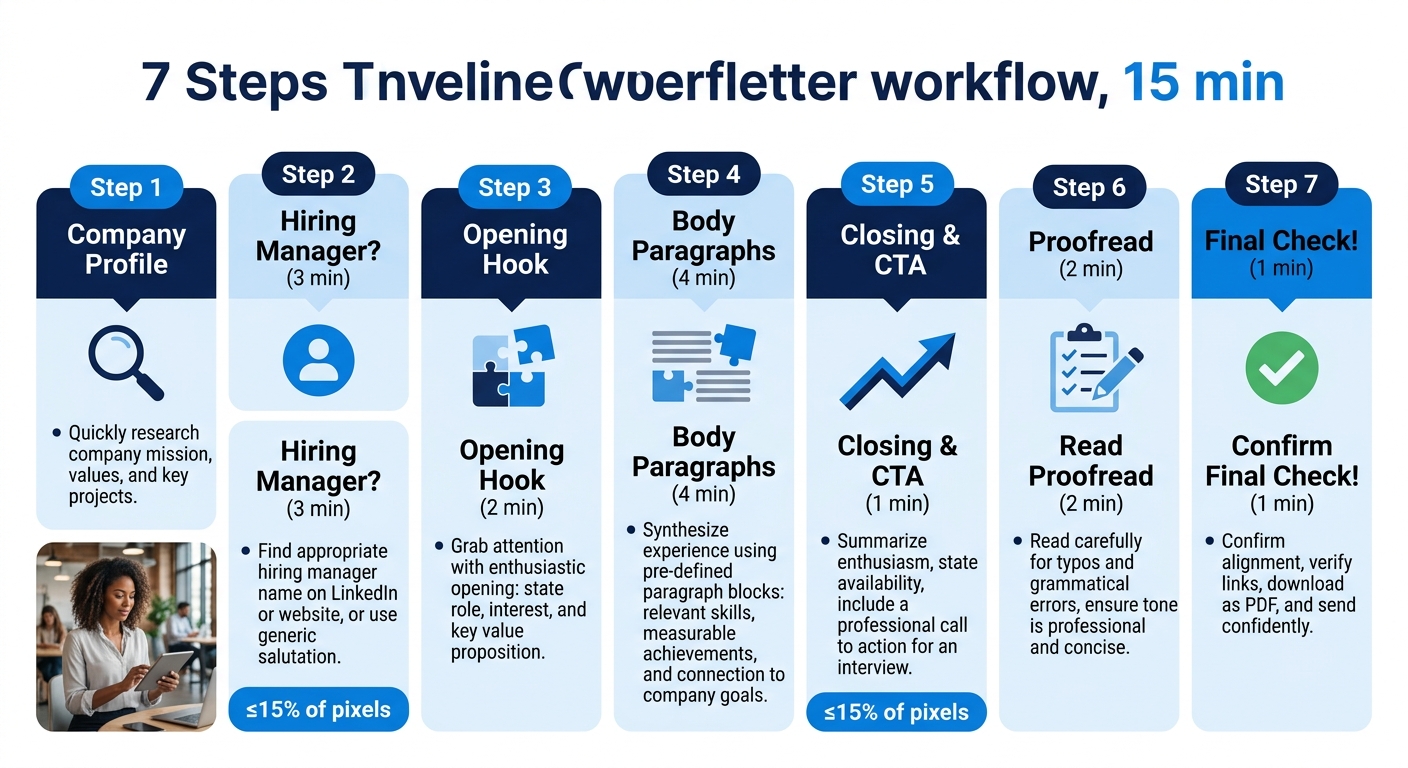
Once your base draft and paragraph library exist, every new application follows the same sequence:
- Read the job description and highlight the top 3-4 required skills
- Look up the hiring manager’s name on LinkedIn (2 minutes)
- Find one recent company development, such as a product launch, funding round, or new initiative (3 minutes)
- Write a 1-2 sentence opening that names the role, the manager, and the development (3 minutes)
- Select 2-3 modular paragraphs matching the highlighted skills and drop them in (2 minutes)
- Mirror 3-4 keywords from the posting into your existing paragraphs (3 minutes)
- Write a closing sentence referencing a specific company initiative (2 minutes)
Total time: 15-20 minutes, compared to the 45-60 minutes a from-scratch letter requires. Candidates who use personalized applications report securing roles within 1-3 months, with 93% landing positions within that window. That’s a significant compression from the 5-month average for applicants sending untargeted submissions. The cover letter template you build once pays dividends across every application that follows.
Tip: Keep your modular paragraph library in a single document with clear labels. When you sit down to apply, you should be able to scan, select, and paste within 60 seconds. The system only works if the retrieval step is frictionless.
What Still Isn’t Settled
Several tensions in cover letter personalization don’t have clean answers yet. AI detection in hiring is getting more sophisticated, but the detection tools themselves vary wildly in accuracy. Some flag perfectly human-written text as AI-generated, while others miss obvious machine output entirely. There’s no industry standard for how companies handle AI-assisted applications, which means the safest approach remains heavy personal editing of any AI-generated draft.
The “optional cover letter” question is similarly unresolved. The 72% figure for hiring managers who expect one even when the posting says optional is high enough to make skipping it a real risk. But some hiring managers genuinely don’t read them, and you won’t know which camp yours falls into before you apply. When the choice is ambiguous, include one. A 15-minute tailored letter has almost no downside, and the upside (standing out from the 45% who don’t bother customizing at all) is substantial.
The biggest open question is how long cover letters remain a standard application component. Some companies have already moved to short-answer application questions or video introductions, and the format itself is clearly evolving. But for the overwhelming majority of job postings today, a well-built cover letter framework with a base draft, modular paragraphs, and three targeted customization zones remains the fastest way to get from “I should apply” to “application submitted” without sacrificing the personalization that hiring managers reward.