


 4.9
4.9 4.5
4.5Resumes containing quantified achievements receive 40% more interview callbacks than those built on duty descriptions, yet production and manufacturing professionals who track OEE, scrap rates, and cycle times every shift routinely write the least quantified resumes in any hiring pool. The gap between what you measure at work and what appears on your resume is where interviews get lost.
The Measurement Paradox on the Production Floor
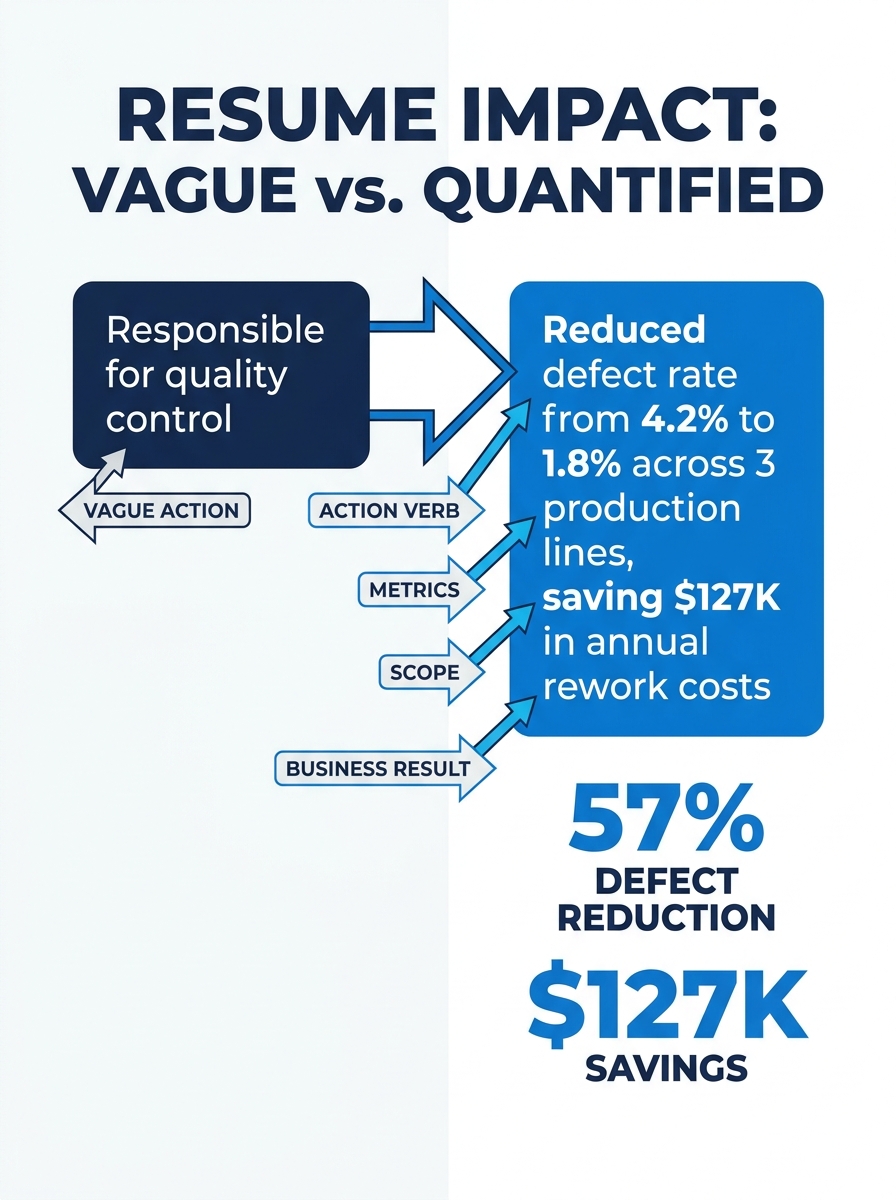
Why do the people surrounded by the most operational data write the emptiest resume bullets? Because production workers think of metrics as belonging to the process, not to themselves. A line operator watches first-pass yield climb from 88% to 94% over a quarter but attributes the improvement to a new fixture design, a team effort, or updated SOPs. The individual contribution gets buried under collective ownership, and the resume bullet becomes “Operated CNC machinery and ensured quality standards.” That bullet tells a hiring manager exactly nothing about your impact.
According to research from Teal, quantifiable achievements on resumes should include sales figures, cost reductions, project timelines, customer satisfaction ratings, and productivity improvements. Those categories map directly onto manufacturing KPIs. Production environments generate dozens of measurable data points per shift: throughput volume, defect rates per thousand units, machine uptime percentages, changeover times, safety incident frequency, and on-time delivery percentages. The raw material for strong resume impact statements already exists in your daily work. You’re just not claiming it.
The second reason for the gap is structural. Many manufacturing roles come with job descriptions written by HR departments that emphasize compliance language over outcome language. When you sit down to update your resume, the easiest reference document is your job description, and so you end up parroting phrases like “Responsible for maintaining equipment” or “Ensured compliance with safety protocols.” These phrases describe the job. They say nothing about how well you did it, what changed because you were in the role, or why a new employer should care that you held it for four years.
Finding Your Numbers When You Don’t Think You Have Any
The most common objection production professionals raise about quantifiable achievements in manufacturing goes something like this: “I don’t have access to the company’s financial data” or “I never got credit for specific cost savings.” Both objections are reasonable and both miss the point. You don’t need access to the CFO’s spreadsheet to build credible production resume metrics. You need to think about your work through four measurement lenses that map onto what manufacturers call core operational KPIs: volume, quality, speed, and cost.
Volume is the simplest. How many units did your line produce per shift? How many orders did you process per week? How many machines did you operate simultaneously? If your line ran 1,200 units per shift and you were one of three operators who consistently hit that target while others averaged 950, that difference is yours to claim. Even if you don’t know the exact dollar value of the gap, the percentage difference (26% above average) communicates impact clearly. And 78% of hiring managers cite metrics as the most persuasive element on a resume. They don’t need your numbers to be financial. They need them to be specific.
Quality metrics live everywhere on a production floor, tracked obsessively by QA departments. Your scrap rate, your rework percentage, your first-pass yield, your customer return rate on products from your line: these numbers exist in systems you interact with every day. An operator who helped reduce scrap from 5.3% to 2.1% on their cell has a concrete story to tell. A quality technician who implemented a new inspection protocol and saw customer complaints drop by 34% over six months has a bullet that will outperform “Conducted quality inspections” in any ATS scan and in any human review. Resumes that include percentages or dollar amounts are 2.5 times more likely to pass initial ATS screening compared to those without any numerical markers, which means your already-existing quality data has direct value in the hiring pipeline.
Speed translates into changeover times, cycle times, and on-time delivery rates. If you cut changeover time on a stamping press from 45 minutes to 22 minutes by standardizing die setup procedures, that’s a 51% reduction. If your shift consistently met the 97% on-time delivery target while the plant average sat at 91%, the 6-point gap becomes your differentiator. Cost is the lens that feels hardest, but you can estimate without needing a P&L statement. A 12-minute reduction in changeover time across 4 changeovers per shift across 250 working days is 200 hours of recovered production capacity per year. At a conservative line rate, that’s real output you enabled, and a hiring manager in manufacturing will do the math themselves.
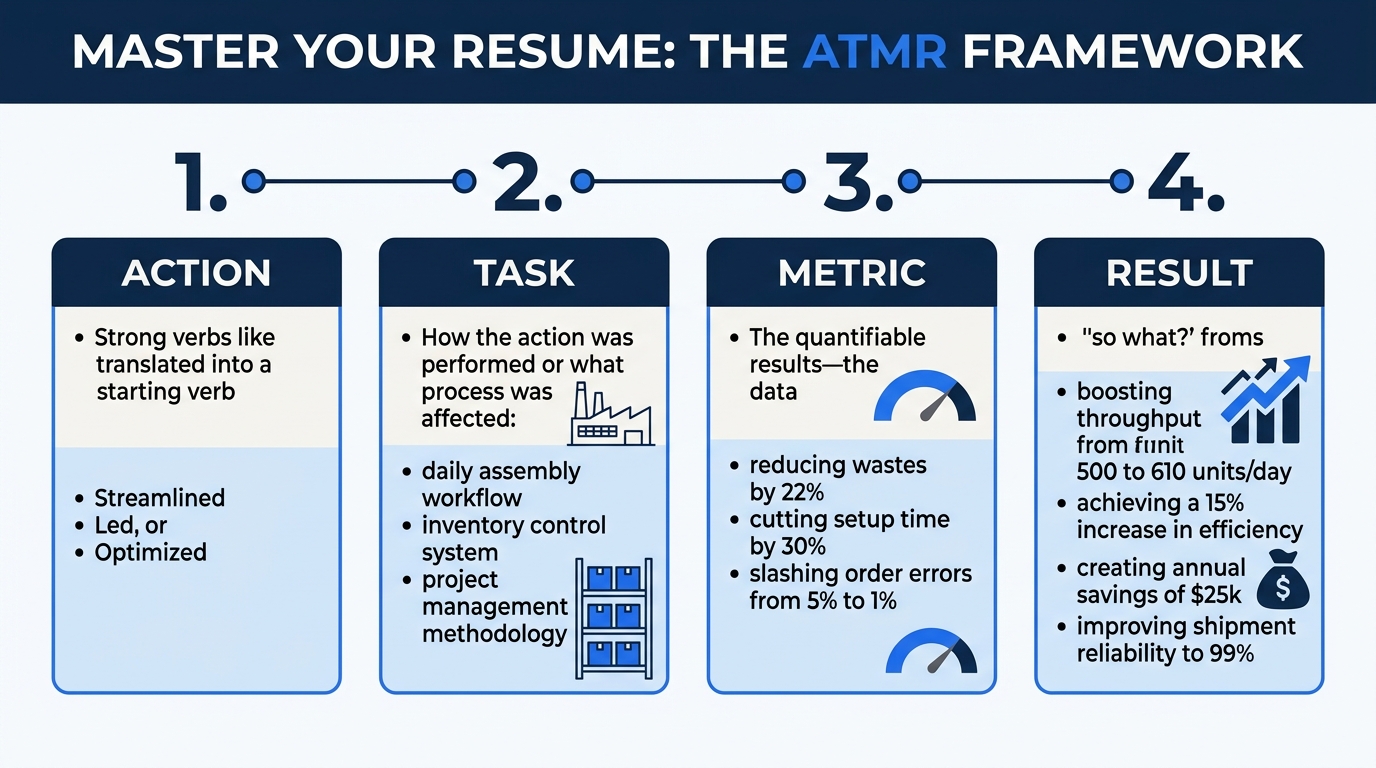
The framework that works best for assembling these lenses into actual bullets borrows from what hiring researchers call the Action-Task-Metric-Result (ATMR) structure. You name the specific action you took, the task it addressed, the metric that moved, and the business result that followed. The Interview Guys highlight an example like “Reengineered manufacturing processes, reducing production costs by 28% while maintaining quality standards” as demonstrating improvement capability clearly and credibly. The verb choice matters here too. ATS-friendly action verbs for operations roles, words like reduced, increased, implemented, redesigned, standardized, calibrated, and coordinated, carry more weight with both automated screening systems and human readers than passive constructions like “was responsible for” or “helped with.” If you’ve been writing your bullets in passive voice, switching to active construction with a strong verb is one of the highest-return changes you can make. And the same action verb audit process that separates descriptive language from outcome language will reveal where your current resume is leaking credibility.
Estimation, Honesty, and Where They Collide
Here’s where this gets uncomfortable, and where honest career advice diverges from the polished guidance in most resume articles. You won’t always have exact figures. Maybe you changed jobs and lost access to the production dashboards. Maybe the improvement happened gradually and nobody ran a before-and-after comparison. Maybe the win was a team effort and you genuinely can’t isolate your contribution from the other seven people on the line.
The professional consensus, backed by extensive discussion in practitioner communities like r/resumes (where a thread on quantifying achievements drew 215 votes and 62 comments from professionals wrestling with this exact problem) and r/ExperiencedDevs, is that reasonable estimation is acceptable and expected. When exact figures aren’t available, the working standard is to use rounded estimates (such as “approximately 10%”), relative terms (“cut processing time by half”), or quantify inputs like team size and project scope rather than fabricate precise results. A production supervisor who knows their line improved but can’t recall whether defect rates dropped by 18% or 22% is fine writing “reduced defect rates by approximately 20%.” The key word is reasonable. Claiming a 60% improvement when the real number was closer to 15% will unravel during any competent behavioral interview.
The places where estimation works well and the places where it falls apart tend to correlate with how verifiable the claim is. Saying you managed a team of 14 operators across 3 shifts is checkable, so don’t round 9 people up to 14. Saying you improved throughput by roughly 12% when the actual improvement was somewhere between 10% and 15% is a defensible approximation that communicates impact without overclaiming. The professionals who run into trouble are the ones who skip estimation entirely (leaving their resume bare of numbers) or who treat estimation as license to invent. If you’ve been struggling with how much detail to pack into a production resume, the answer is almost always more specificity per bullet rather than more bullets per page.
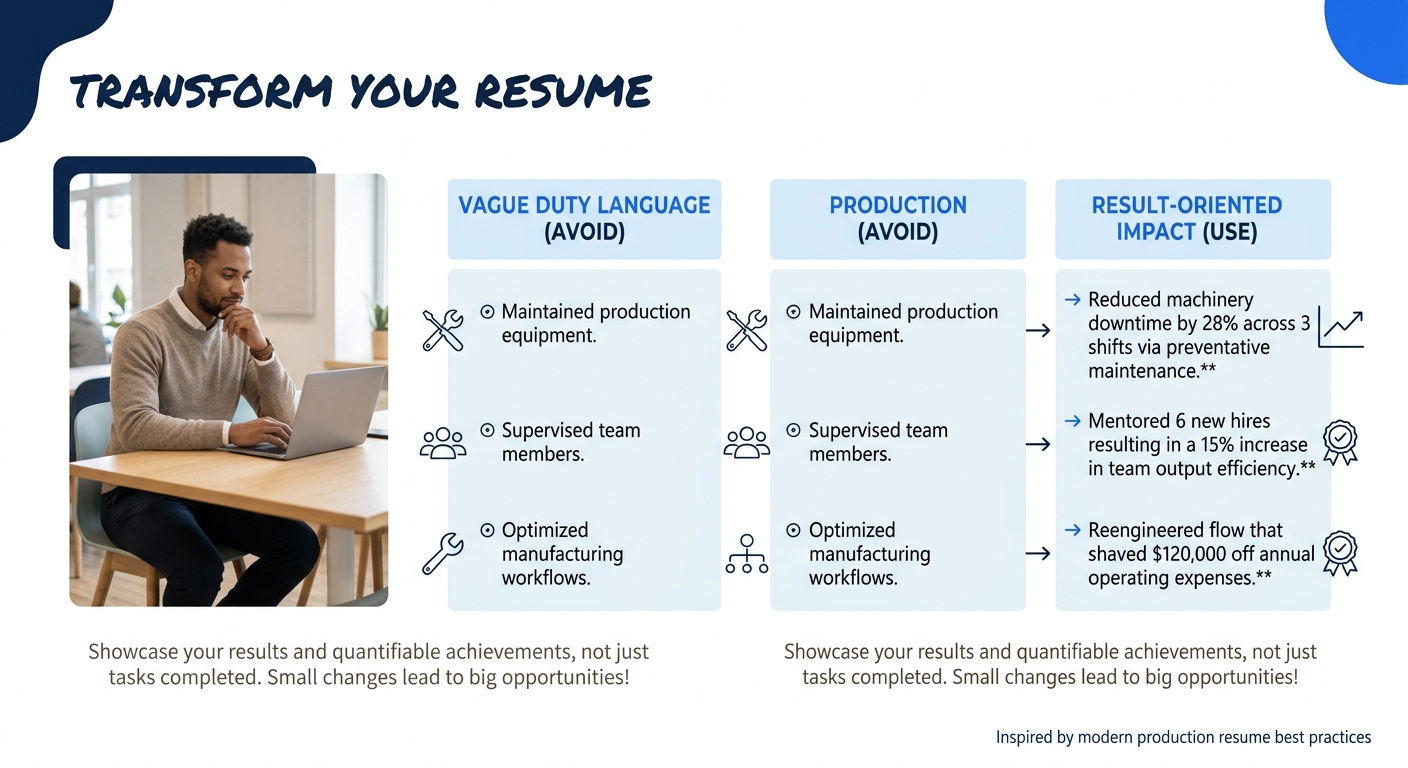
Start with what changed. Then work backward to what you did that contributed to the change. Then attach whatever number, exact or estimated, gives the hiring manager a sense of magnitude. The difference between “Maintained packaging equipment” and “Performed preventive maintenance on 8 packaging lines, reducing unplanned downtime by 35% and contributing to a plant-wide OEE increase from 72% to 81%” is the difference between a resume that describes a job and a resume that describes a person worth interviewing. One of those gets past the recruiter’s initial screen. The other sits in a pile with forty identical applications.
What Quantification Can’t Capture
There’s a limit to this approach, and pretending otherwise does production professionals a disservice. Some of the most valuable work on a manufacturing floor resists clean numerical capture. Mentoring a struggling junior operator until they passed their 90-day performance review doesn’t map neatly onto a percentage. Building cross-functional trust between quality and production teams so that root cause investigations actually produce corrective actions is a genuine achievement, but quantifying it in a resume bullet requires contortion that often sounds forced. The ATMR framework handles these situations less gracefully, and the honest move is to acknowledge that some bullets will lean on qualitative description supported by scope indicators (team size, number of departments involved, duration of the initiative) rather than pure outcome metrics.
The bigger unresolved tension sits between two pieces of advice that both happen to be true. On one side, 78% of hiring managers want numbers. Resumes with metrics get 40% more callbacks. ATS systems privilege digits. Everything in the data says to quantify. On the other side, a production resume stuffed with 22 different percentages starts to feel performative, especially when every number is a rounded estimate and none of them can be verified before an interview. The operations manager who rebuilt her resume around process outcomes and landed three interviews in ten days did so by choosing her strongest three or four metrics and supporting the rest with clear, specific language about scope and contribution. She didn’t quantify everything. She quantified the right things.
The gap between what you measure at work every day and what appears on your resume is where interviews get lost.
The measurement gap on production resumes persists because the culture of manufacturing values collective output over individual credit-taking. Operators think in terms of the line’s performance, not their own. Supervisors attribute wins to their teams, which is admirable leadership and terrible resume strategy. Closing this gap doesn’t require inventing a version of yourself that single-handedly saved the plant $2 million. It requires looking at the data you already touch every day (the shift reports, the SPC charts, the downtime logs, the yield summaries) and asking one question: what was different because I was here? The answer to that question, expressed in specific terms with whatever numbers you can reasonably attach, is what separates a resume that describes a role from one that earns a phone call.