


 4.9
4.9 4.5
4.5Every piece of resume advice telling non-technical professionals to “add metrics” is solving the wrong problem. The real challenge isn’t finding numbers to include. It’s knowing which numbers actually change a hiring manager’s assessment, because the metrics people default to (team size, years of experience, number of tasks handled) communicate volume without communicating value.
TL;DR: A 2025 Resume Now analysis of 18.4 million U.S. resumes found only 10% include measurable results, and the figure drops to 2% in non-technical fields like healthcare support. The fix isn’t scattering random numbers across your bullet points. It’s running every achievement through four measurement dimensions (money, people, time, volume) and choosing the one that proves a change you caused.
The 10% Problem and Why Almost No One Gets Resume Metrics Quantification Right
A 2025 Resume Now study analyzing 18.4 million U.S. resumes discovered that only 10% include any measurable results at all. In non-technical fields, the number collapses further: just 2% of resumes in building and grounds maintenance, and a similarly thin percentage in healthcare support roles, contained a single quantifiable achievement. Professionals with 10+ years of experience were more than twice as likely to include metrics than those earlier in their careers, which suggests that learning to quantify impact is something people figure out slowly, by accident, rather than through any deliberate system.
The gap exists because resume advice typically assumes you already know what to measure. “Add numbers” sounds simple. But an office manager staring at a blank bullet point doesn’t instinctively know whether to count invoices processed per week, error rates, or dollars saved through vendor negotiations. A customer service representative might default to “handled 90+ calls daily,” which tells a recruiter about workload but says nothing about whether those calls went well. As the career advisory team at Hays wrote in their analysis of quantifiable CV results, “when you say, ‘Delivered 11 cross-functional projects on time with 54% of those under budget,’ you’re showing measurable success.” The distinction between volume and value is where most resumes fail.
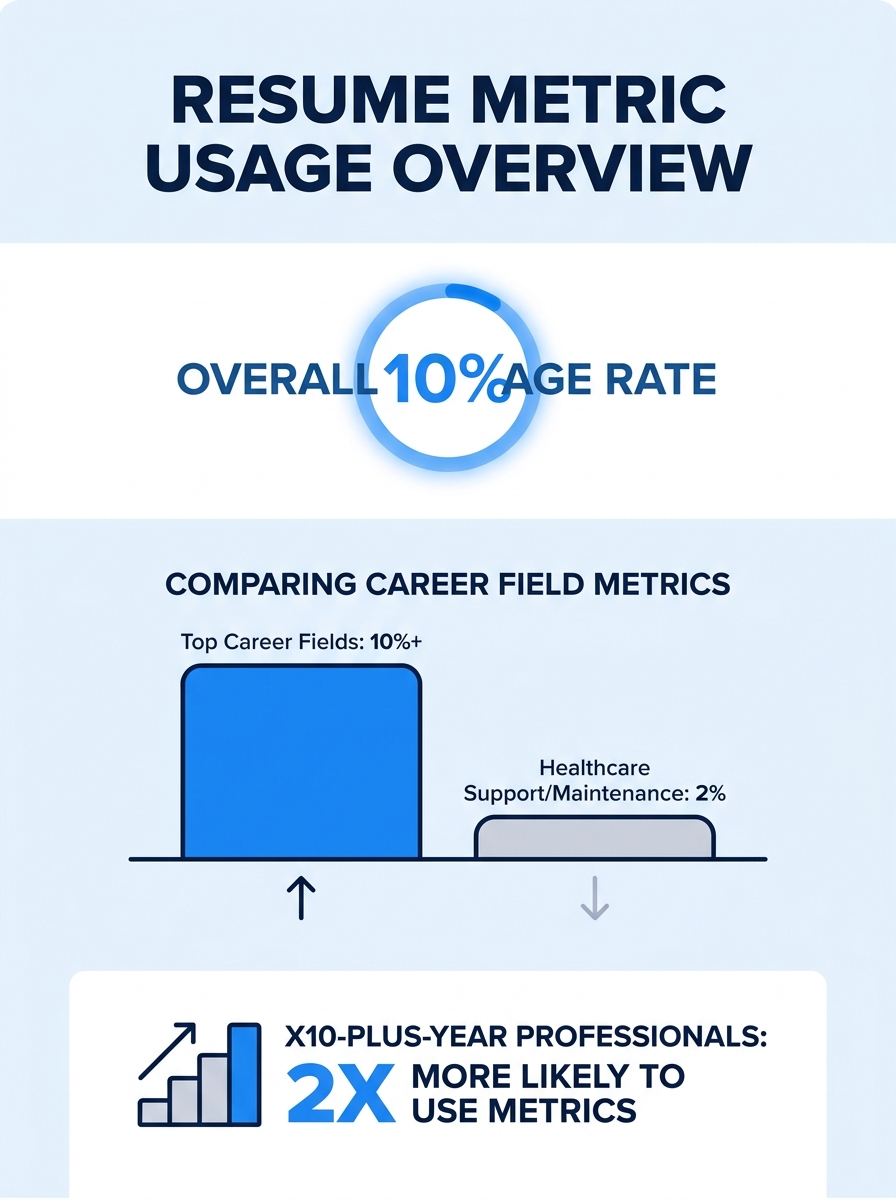
This data reframes the whole conversation around resume metrics quantification. If 90% of resumes lack measurable results, the bar for standing out is lower than you’d expect. You don’t need perfect data or access to a company analytics dashboard. You need a consistent method for identifying which of your daily activities produced a change someone else can verify.
The Four-Lens Metrics Audit
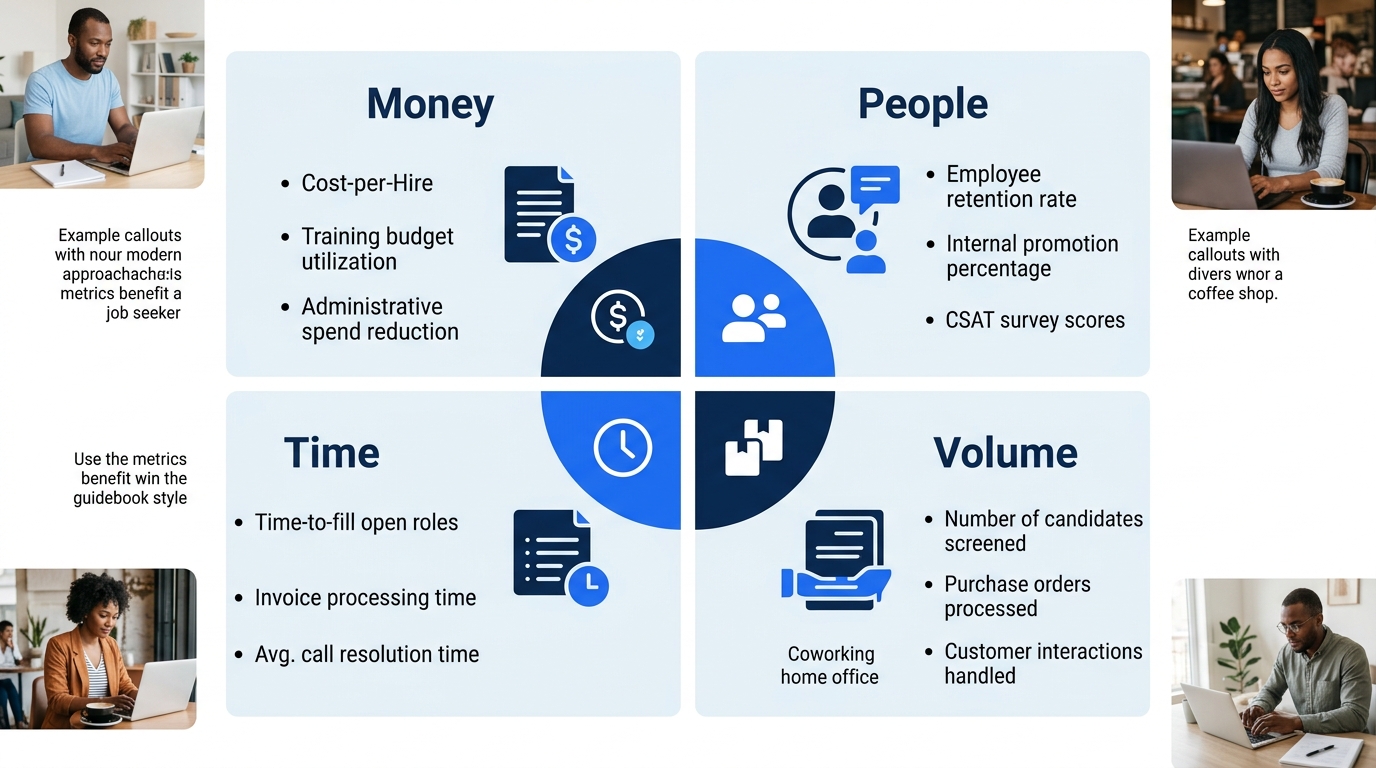
Resume.io’s April 2026 resume guidance identifies four universal dimensions for quantification applicable to any role: money, people, time, and volume. I want to build on that framework into something you can use as a diagnostic tool. Call it the Four-Lens Metrics Audit: for every bullet point on your resume, ask which of these four dimensions best captures the change you created.
Money is the lens most people think of first, but it’s accessible to more roles than you’d assume. An administrative assistant who consolidated office supply vendors and cut annual spending by approximately $15,000 has a money metric. An event coordinator who managed a $120,000 annual conference budget and came in 8% under target has one too. You don’t need P&L ownership to claim financial impact. Cost avoidance, budget adherence, and waste reduction all qualify.
People covers team size, retention, hiring outcomes, training results, and engagement scores. An HR generalist who reduced voluntary attrition from 18% to 11% over 18 months across a 4,500-employee organization is telling a powerful story. If you mentored 8 junior staff members and 7 received promotions within 18 months, that’s a people metric with a built-in success rate of 87.5%.
Time captures efficiency gains, cycle reductions, and speed improvements. Reducing average onboarding setup time from 5 days to 2 days, cutting month-end closing by 3 days, or decreasing average email response time from 48 hours to 12 hours all prove you made a process faster. Time metrics are especially strong for administrative, operations, and project management roles where the core job is keeping things moving.
Volume is the dimension people overuse. Handling 90+ calls daily or processing 50+ invoices weekly tells a recruiter you were busy, but it doesn’t prove you were effective. Volume works best when paired with a quality indicator: “Managed scheduling for approximately 200 monthly client appointments while maintaining a 98% on-time service rate.” The volume establishes scale; the quality metric establishes competence.
Tip: When you’re stuck, start with the Time lens. Almost every role involves a process that takes a certain amount of time, and almost every competent employee has made at least one of those processes faster. Time metrics are the easiest to estimate even without access to formal tracking systems.
The real goal of translating soft skills to numbers is picking the lens that shows transformation, not activity. A customer service bullet that reads “Achieved 85% customer satisfaction rating, 15% higher than the company average, while reducing cancellations by 5%” uses three of the four lenses simultaneously (people/satisfaction, volume/cancellations, and an implicit time dimension in the comparison period). That density of achievement measurement in non-technical roles is what separates a resume that gets a 6-to-8-second scan from one that earns a phone screen. Monster’s 2026 Resume Trends report confirmed that measurable results rank among the top factors influencing recruiter decisions within that narrow scan window.
Before and After: What Resume Impact Analysis Looks Like in Practice
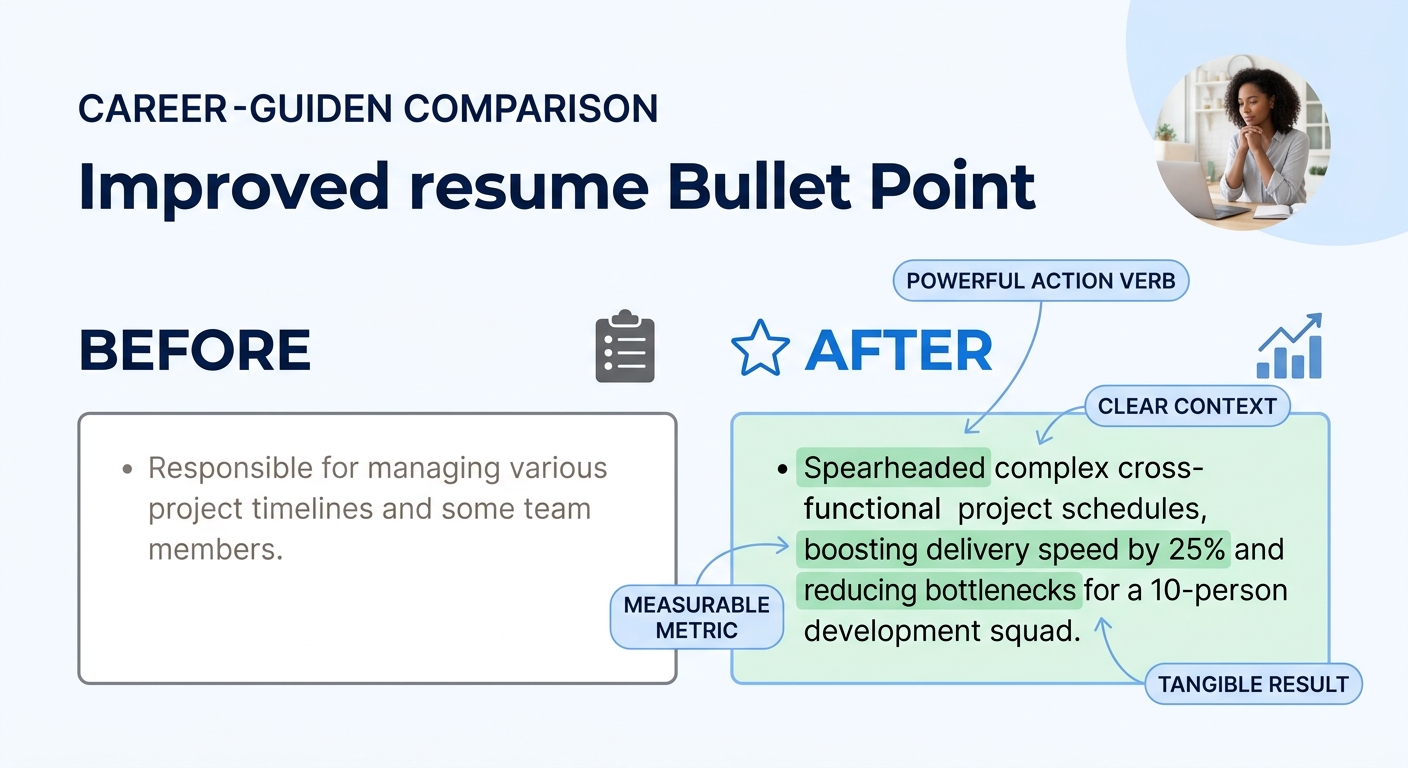
Why does the formula matter more than the individual numbers? Because structure is what makes a metric readable under pressure. The recommended format across multiple career advisory sources follows a consistent pattern: action verb + context + metric + result. WahResume.com’s 2026 resume writing guidance calls this the maximum-clarity format for non-technical bullet points, and it maps closely to the STAR method recommended by Monster for translating competencies into measurable achievements. Here’s what that transformation looks like across five common roles:
Office Manager (Before): “Responsible for ordering supplies and managing vendor relationships.” Office Manager (After): “Consolidated 4 office supply vendors into 1 preferred partner, reducing annual procurement costs by $15,000 and cutting order processing time from 3 days to same-day fulfillment.”
Customer Service Rep (Before): “Answered customer calls and resolved complaints.” Customer Service Rep (After): “Handled 90+ inbound calls daily with an 85% customer satisfaction rating (15% above company average) while reducing account cancellations by 5% quarter over quarter.”
HR Coordinator (Before): “Assisted with onboarding new employees and organized training sessions.” HR Coordinator (After): “Redesigned the onboarding workflow for a 200-person department, reducing average new-hire setup time by 35% and increasing 90-day retention by 12 percentage points.”
Event Planner (Before): “Planned and executed company events.” Event Planner (After): “Delivered 11 cross-departmental events annually for audiences of 150 to 400 attendees, with 54% completed under budget and post-event satisfaction scores averaging 4.7 out of 5.”
Administrative Assistant (Before): “Managed executive calendars and coordinated meetings.” Administrative Assistant (After): “Coordinated 40+ weekly meetings across 3 time zones for a 6-person executive team, reducing scheduling conflicts by 60% after implementing a centralized booking system.”
If 90% of resumes lack measurable results, the bar for standing out is lower than you’d expect.
Every “after” version uses at least two of the four lenses. Every one includes a specific number. And every one describes a change, not a duty. This approach also works well if you’re auditing your resume builder’s AI-generated suggestions for specificity, because AI tools tend to produce exactly the kind of vague, duty-focused language shown in the “before” examples.
The Connors Group’s March 2026 guidance on resume estimation addresses the most common objection head-on: “I don’t have exact numbers.” Their recommendation is to use responsible approximation with qualifiers like “approximately,” “around,” or the tilde symbol. Writing “Managed scheduling for ~200 monthly client appointments” is infinitely stronger than “Managed a high volume of client appointments.” Recruiters understand that you didn’t have a dashboard counting your appointments to the decimal point. The specificity signals that you thought about your impact, which is precisely what the resume impact analysis process is designed to surface.
Indeed’s resume guidance reinforces where these metrics belong: they recommend placing numbers across four sections of your resume (summary, work experience, skills, and education), which means metrics shouldn’t cluster in your bullet points alone. A summary that opens with “Operations coordinator with 6 years of experience improving departmental productivity by an average of 12% annually across 3 organizations” front-loads quantified credibility before the reader even reaches your work history. And if you’re wondering whether your overall resume format supports this kind of metric density, it’s worth running an ATS format audit to confirm your numbers survive the parsing process intact.
MediaBistro’s March 2026 analysis of competitive resume trends in communications, education, and nonprofit roles found that metrics provide “concrete evidence of contributions” even in fields where outcomes feel inherently qualitative. Training completion rates, grant dollars secured, press coverage reach, and program participation growth all count. The excuse that soft-skill roles can’t be measured has always been a framing problem, not a data problem.
The Claim, Reconsidered
The standard “add numbers” advice isn’t wrong in principle. It’s incomplete in practice. Telling a customer service professional or an HR coordinator to quantify their achievements without giving them a measurement system is like telling someone to cook dinner without mentioning ingredients. The Four-Lens Metrics Audit (money, people, time, volume) provides the missing structure, and the evidence supports treating this as urgent: with only 10% of resumes containing measurable results, professionals who learn achievement measurement for non-technical roles gain an outsized advantage simply by doing what 90% of their competition won’t.
Career experts across the field recommend quantifying 60% to 80% of your achievement bullets, prioritizing relevance to the target role over sheer metric count. If you’re navigating a career shift where your previous metrics don’t map neatly to a new industry, you might find useful framing in our coverage of how career coaching and resume alignment affect interview conversion. And if your concern is whether all these carefully constructed numbers will even reach a human reader, the answer depends on whether your resume survives algorithmic screening first. The core principle holds regardless of your field or the system reading your resume: every role produces outcomes, and those outcomes can be measured along at least one of the four dimensions. The professionals who treat quantification as a skill to develop, rather than decoration to sprinkle on a finished document, are the ones whose applications convert.