


 4.9
4.9 4.5
4.5Three responses exist for the moment a hiring manager names a salary figure: counter immediately with your own number, redirect with questions about the full package, or say absolutely nothing. A 2025 Harvard-UCLA study found that 85% of candidates who counter receive improved terms, yet only 31% of employees attempt any compensation negotiation at all. The gap between those numbers is where careers quietly lose tens of thousands of dollars.
TL;DR: Silence is the highest-return salary negotiation tactic, but it’s used least because candidates mistake the discomfort of a pause for rejection. Among the 31% who negotiate at all, 85% succeed. The three-to-seven-second pause consistently outperforms both immediate counters and question redirects, but each approach has specific situations where it fits best.
That 31% negotiation rate is down from 49% the prior year, according to the same research. The candidates who did push back gained an average of $27,000 in annual salary. So roughly 69% of the workforce accepts the first number they hear, and the cost compounds through every raise, bonus, and retirement contribution calculated on a base salary that was never challenged.
What separates the 31% from the 69% usually comes down to which of three responses a candidate defaults to when the silence arrives.
Countering Right Away
The instinct to respond to a number with another number has legitimate tactical roots. Anchoring theory, one of the most studied phenomena in behavioral economics, shows that the first number in any negotiation disproportionately influences the final outcome. If you counter fast with a well-researched figure, you plant your own anchor before the employer’s number becomes the default.
The upside is clarity. You signal that you’ve done your homework, you know your market value, and you’re ready to talk money directly. Hiring managers often report that a specific, data-backed counter feels more professional than a vague “I was hoping for more.” Harvard’s Program on Negotiation advises that even when you plan to counter, you should resist the urge to respond immediately and instead ask for time to think it over so you can strategize.
But here’s where the immediate counter breaks down. When you respond to “$95,000” with “$110,000” within the first few seconds, you’ve compressed the negotiation into a number-versus-number exchange. The employer now has a bracket ($95K to $110K) and will typically split the difference. You’ve also revealed your ceiling. If the company had budget for $120,000, you’ll never know it.
The speed of the response also signals anxiety. Candidates who fire back instantly often come across as having rehearsed a script rather than genuinely evaluating the offer. And if your counter happens before you’ve asked about the full compensation package (equity, bonuses, PTO, signing bonus, remote flexibility), you’ve narrowed the negotiation to base salary alone when the total package might have offered more room.
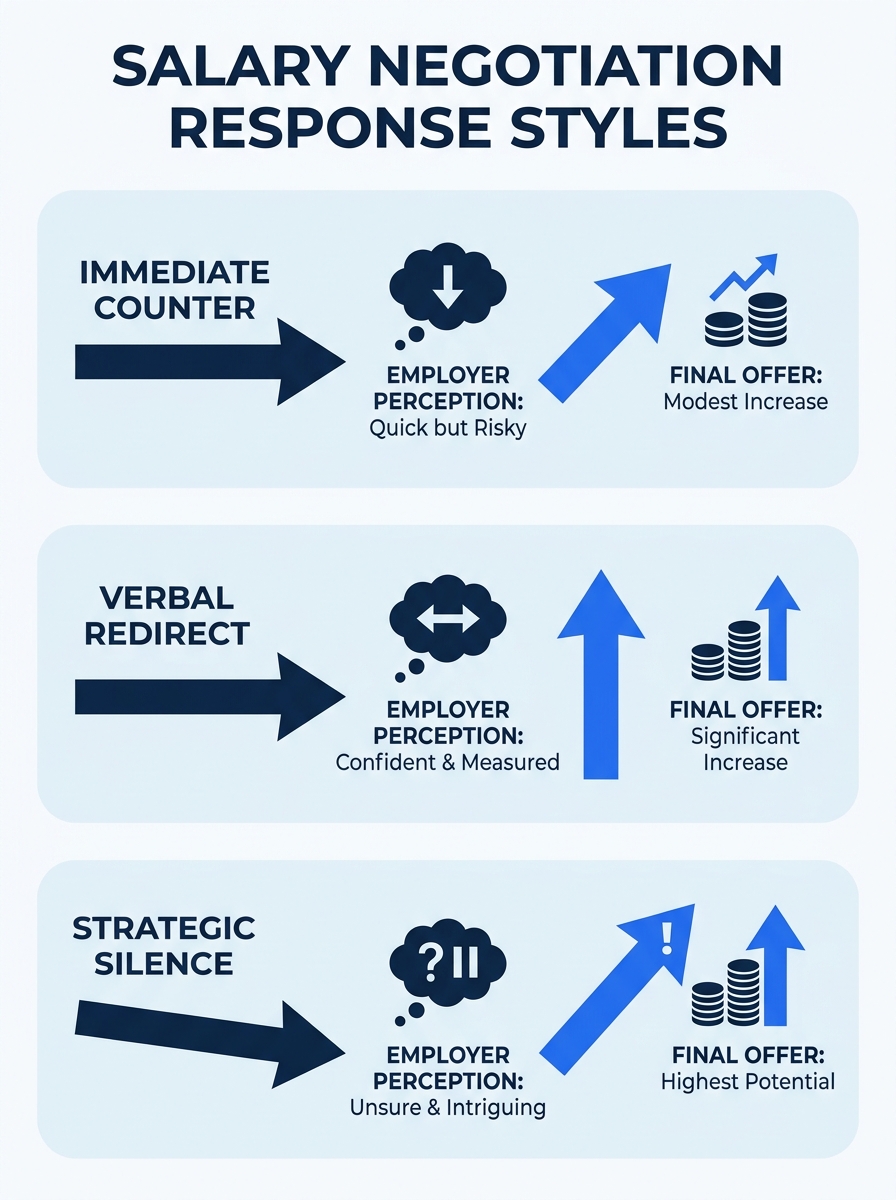
When the Immediate Counter Wins
This approach works well when you’re negotiating from a position with a competing offer in hand, when the initial number is clearly below market by 15% or more, and when you have specific data (Glassdoor ranges, competing offers, industry benchmarks) ready to cite. It’s the right move for people who have already prepared their resume to quantify specific achievements and can carry that same precision into the compensation conversation. The key is anchoring with your number, not reacting to theirs.
Asking Questions Instead of Answering
The second approach replaces silence with curiosity. Instead of countering with a number or going quiet, you respond with questions: “Can you walk me through how you arrived at that figure?” or “What does the full compensation package look like beyond base?” or “Is there flexibility in the equity structure?”
This counter offer strategy has real advantages. The Salary Negotiator advises that asking for more information will “strengthen your counteroffer and can lead to additional wins” beyond what you initially expected to negotiate. You discover the employer’s priorities, their budget constraints, and which parts of the package have the most flexibility.
The questioning approach also buys time without creating the discomfort of silence. You’re engaged, you’re showing interest, and you’re gathering intelligence that makes your eventual counter more precise. For candidates who find silence physically uncomfortable, this approach offers a genuine middle path that keeps the conversation moving while you process the number internally.
The limitation is that questions can signal uncertainty. If you ask three or four clarifying questions before stating your position, the hiring manager may read that as someone who doesn’t know what they want. Questions can also accidentally anchor you to the employer’s frame. When you ask “Is there flexibility in the $95,000 figure?”, you’ve accepted $95,000 as the starting point. A stronger move might have been to never acknowledge that number directly.
When Questions Work Best
Question-based redirection delivers the highest value in complex negotiations with multiple compensation elements (equity packages, relocation, bonus structures) and when you genuinely need more information to evaluate the offer. It’s particularly effective during panel-style interviews where the offer discussion happens in a multi-person setting and silence could feel confrontational rather than strategic. It’s also the strongest approach when the offer arrives verbally and unexpectedly, before you’ve had any time to prepare.

Saying Nothing at All
Katie Donovan, founder of the consultancy firm Equal Pay Negotiations, puts the negotiation silence technique bluntly to her clients: “The first step is to be silent, hush up, or SHUT UP!”
The instruction sounds simple. The execution is brutal. When a hiring manager says “$95,000,” every instinct in your body pushes you to respond. Your brain will interpret the silence as hostile, as awkward, as a sign that the offer is about to be withdrawn. None of that is accurate.
What’s actually happening during those silent seconds is a power transfer. Harvard’s Program on Negotiation researchers have documented that silence improves listening, defuses aggressive tactics, reduces bias, and creates emotional control. MIT Sloan research confirms that pauses of three seconds or more often precede negotiation breakthroughs because they shift both parties from reactive to reflective thinking.
Silence creates a psychological need for closure. When you don’t respond, the hiring manager feels compelled to fill the gap. And the way they fill it almost always works in your favor. They might say “…but there’s flexibility in that number.” They might add “We could also discuss a signing bonus.” They might revise upward before you’ve said a word. The employer, having already completed a full interview loop and invested weeks of calendar time in selecting you, isn’t going to walk away because you took ten seconds to think.
The company has already decided they want you. The post-offer period is your strongest negotiation position, not your weakest.
The Three-to-Seven-Second Window
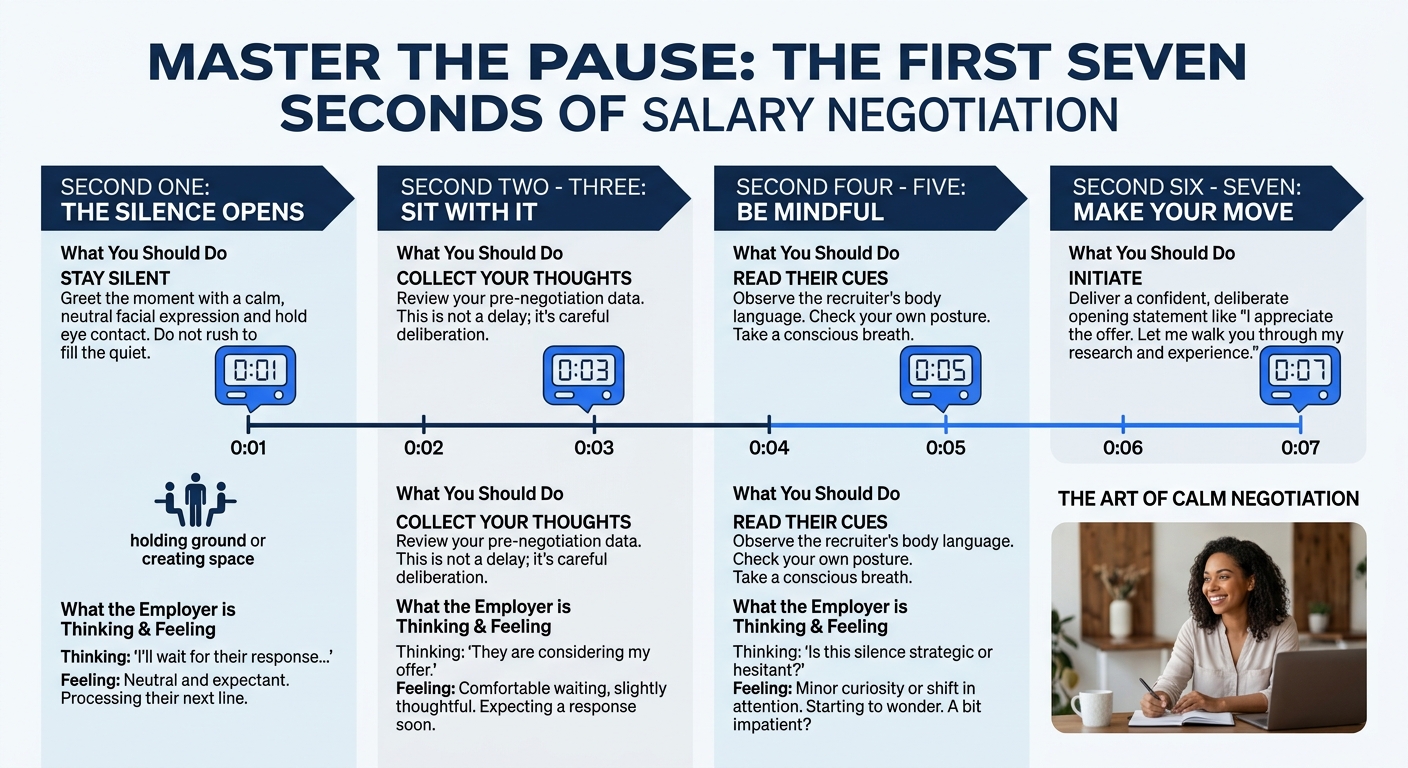
MIT Sloan’s research points to three seconds as the minimum effective pause. Anything shorter gets read as normal conversational rhythm. Anything longer than about eight seconds starts to feel genuinely confrontational over a phone or video call (in person, body language fills the gap, so you can stretch it further). The sweet spot for most salary negotiation tactics sits between four and seven seconds. That’s long enough to trigger the employer’s need to add information, short enough to avoid hostility.
What you do during those seconds matters. Make eye contact if you’re in person. Nod slightly. Let your expression show that you’re considering the number seriously. On a phone call, a brief “Hmm” or audible breath communicates contemplation rather than confusion. And if you’re on video, lean back slightly. The physical movement reinforces that you’re reflecting, not frozen.
The Negotiation Training Institute notes that pausing to revisit your preparation, including your BATNA (best alternative to a negotiated agreement) and your walk-away point, “helps you regain perspective and composure.” That internal review is exactly what the silence gives you time to do.
When Silence Falls Short
Strategic silence delivers the highest returns when the initial offer is reasonable but not exceptional. If the offer is insultingly low (30% or more below market), silence won’t close that gap by itself. If the offer already exceeds your expectations, silence might extract marginal gains at the cost of goodwill. The technique shines brightest in that broad middle range where the employer has room to move and your quiet gives them permission to do so.
This approach also pairs well with the broader positioning work you’ve done earlier in the process. If you’ve invested in aligning your coaching with your resume narrative, you’ll enter the offer conversation with the confidence to tolerate a few seconds of quiet. Confidence and silence reinforce each other.
Side-by-Side Comparison
| Attribute | Immediate Counter | Question Redirect | Strategic Silence |
|---|---|---|---|
| Speed of response | Under 5 seconds | 10–30 seconds | 4–7 seconds of nothing |
| Information revealed | Your target number | Your areas of concern | Nothing at all |
| Employer’s likely reaction | Brackets the negotiation | Provides more detail | Often improves terms unprompted |
| Risk of anchoring yourself | High | Moderate | None |
| Difficulty for candidate | Low (feels natural) | Low to moderate | High (feels unnatural) |
| Best scenario | Strong alternative offers, clearly low-balled | Complex multi-element packages | Reasonable offers with room to improve |
| Typical outcome | Split-the-difference settlement | Better understanding of package | Employer-initiated improvement |
Tip: You don’t have to commit to one approach for the entire conversation. The strongest negotiators use silence first (4–7 seconds after hearing the number), then shift to questions about the full package, and only counter with a specific number once they’ve gathered enough information to make that number precise.
The Verdict
All three approaches work better than saying “yes” to the first number. That’s the real baseline. With 69% of the workforce accepting initial offers without pushback, any structured response to a job offer negotiation puts you ahead of most candidates.
But if you’re choosing a default response for the moment a number hits your ears, silence is the highest-return, lowest-risk option. The 85% success rate for candidates who negotiate, combined with MIT Sloan’s research on reflective pauses, makes a strong case. You give up nothing. You reveal nothing. And you create space for the employer to improve their own offer before you’ve committed to a counter.
The exception matters. If you’re negotiating under real financial pressure, active job seekers don’t have the luxury of a passive candidate who can wait for the right opportunity while collecting a paycheck. When you need the job, the calculus shifts. Silence still works for a few seconds, but the willingness to walk away that gives silence its power gets undermined by your actual situation. In those cases, a well-researched immediate counter with a specific number (backed by Glassdoor data, industry benchmarks, or a competing offer) gives you the best chance at improving terms without risking the offer itself.
For everyone else, the answer is the one Katie Donovan gives her clients. Hear the number. Breathe. Count to five. And let the hiring manager fill the silence with something better than what you would have asked for. The discomfort lasts seconds. The financial impact lasts the rest of your career, compounding through every raise and bonus calculated as a percentage of a base salary you set well at the start. If you’ve been stuck at a competency plateau wondering why your earnings have flattened, the answer often traces back to an offer conversation years ago where you spoke when you should have stayed quiet.