

 4.9
4.9 4.5
4.5Every bullet point about your data migration that names a tool before naming a business result is a bullet point the non-technical hiring manager will skip. Infrastructure professionals lose interviews because their resumes read like architecture diagrams, dense with platform names and protocol references that mean nothing to the person deciding whether to bring them in. Technical resume translation, the conversion of project complexity into outcome language, separates resumes that get screened in from the ones that get filed away.
TL;DR: Non-technical hiring managers screen most infrastructure resumes. They don’t understand your technical stack—they understand cost savings, downtime reduction, and risk mitigation. Reframe every data migration and system architecture bullet around the business result, then satisfy ATS systems with a separate dedicated skills section.
The 6-Second Screening Problem for Technical Resumes
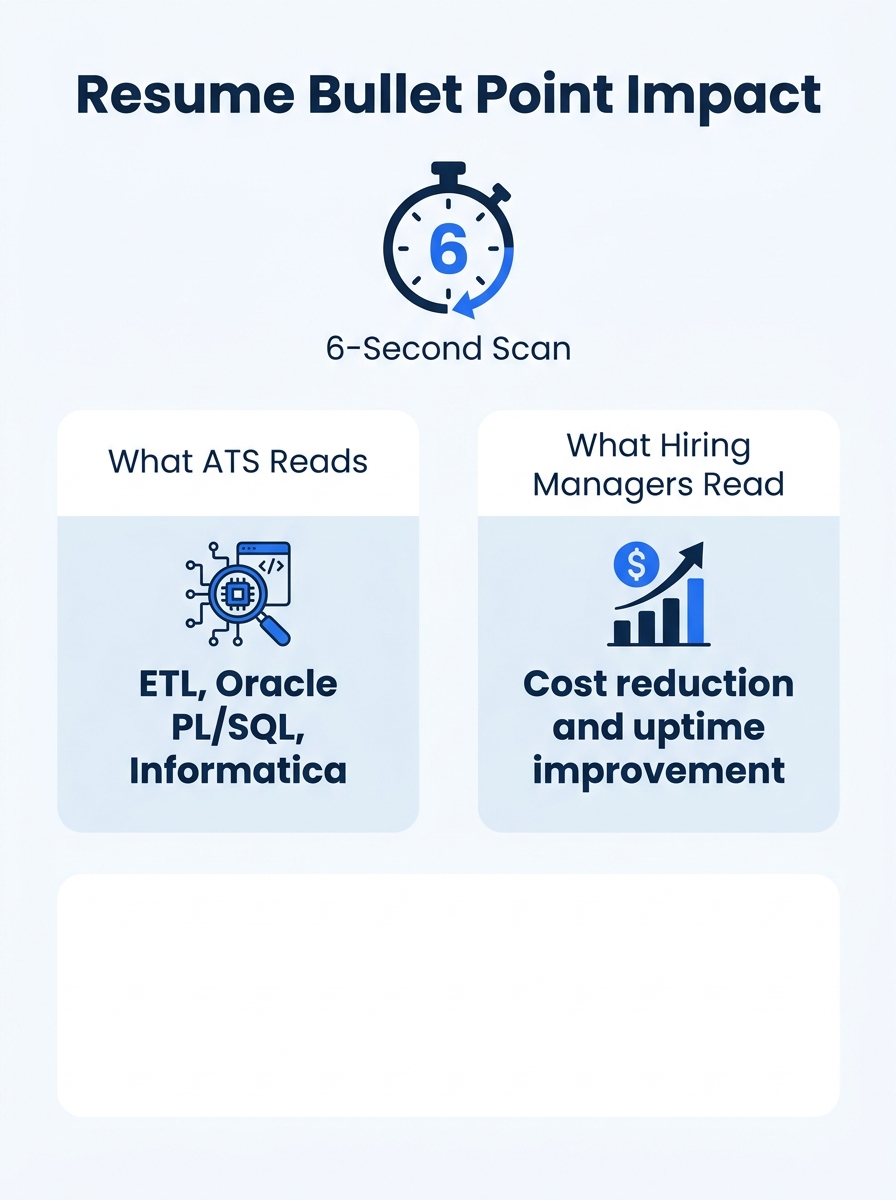
Recruiters spend an average of 6 to 7 seconds on an initial resume scan, according to widely cited eye-tracking research. That window shrinks further when the reader doesn’t have a technical background. A hiring manager at a mid-size logistics company scanning for an infrastructure lead isn’t going to pause and decode “Architected ETL pipeline using Informatica PowerCenter with incremental load patterns across 14 Oracle schemas.” They’re going to move to the next resume.
The disconnect is structural. Data migration resume samples on job boards like Velvet Jobs list requirements such as “proven development skills of writing data migration scripts” and “credible experience of writing scripts in Oracle PL/SQL.” Those phrases belong in a technical skills inventory. They do not belong in your bullet points, because bullet points are what the hiring manager actually reads during those 6 seconds.
According to Teal’s data center migration resume guide, the fix is direct: “Use metrics to demonstrate successful project outcomes, such as reduced downtime or improved efficiency.” Real-world migration resumes that land interviews show outcomes like “managed a data center migration project that reduced IT costs by 20%” rather than listing the migration toolchain.
And the problem compounds at scale. Poor planning remains the number one cause of migration project failure in 2026, according to industry analysis of enterprise migrations. If your resume describes how you migrated without explaining why it mattered, you’re confirming the hiring manager’s suspicion that technical people can’t communicate business value. That suspicion, unfair as it may be, costs you the interview.
The Translation Formula That Turns Technical Projects Into Business Wins
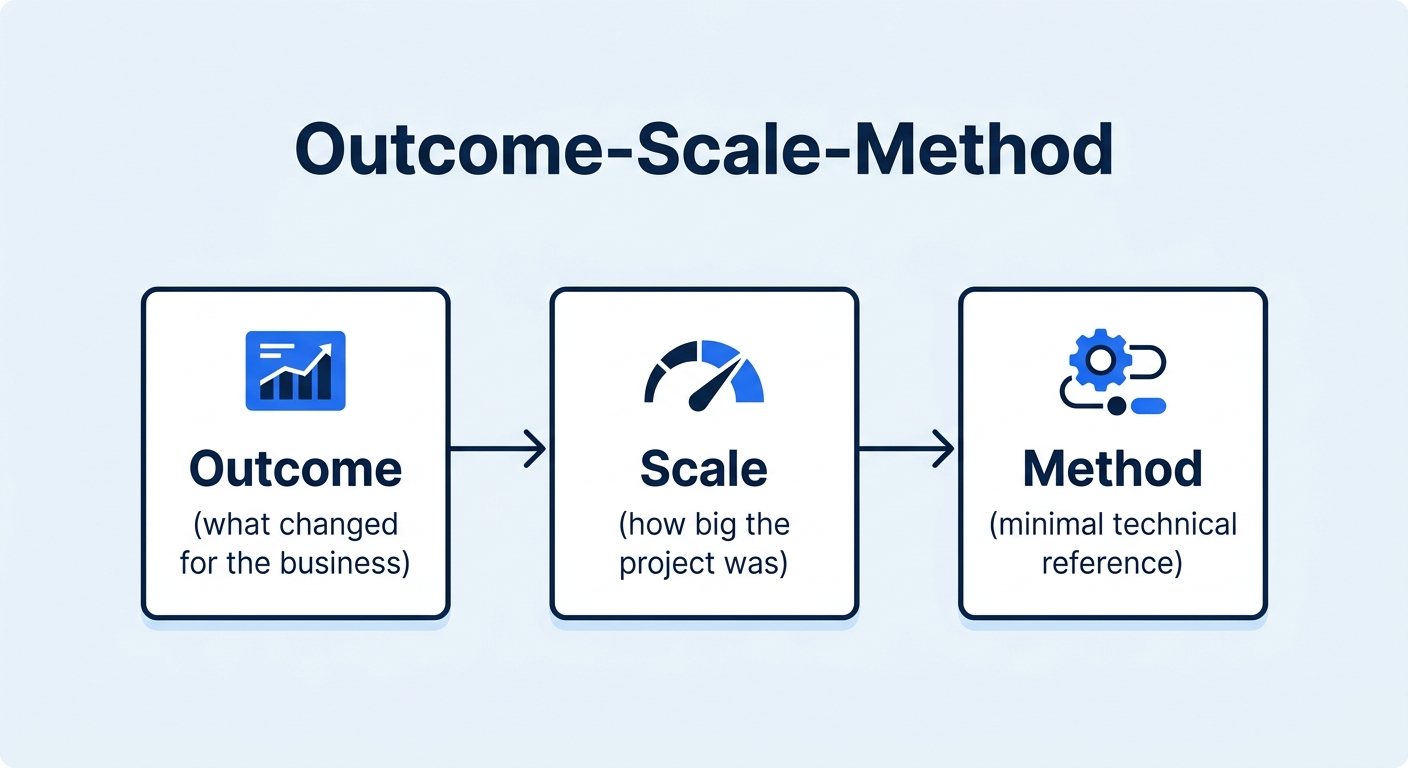
The core challenge of framing technical skills for non-technical audiences is that infrastructure professionals think in systems and hiring managers think in results. Bridging that gap requires a repeatable formula. I call it the Outcome-Scale-Method structure: lead with what changed for the business, follow with the scope of the change, and close with just enough technical context to prove you did the work.
Here’s how it works in practice:
Before (tool-first): “Executed cloud migration of 240 VMs from on-premise VMware environment to AWS EC2 instances using CloudEndure and Terraform.”
After (outcome-first): “Cut annual infrastructure hosting costs by $2M by migrating 240 virtual machines to AWS, completing the transition with zero unplanned downtime across a 14-week rollout.”
Both sentences describe the same project. The second one tells a non-technical hiring manager three things they care about: money saved ($2M), reliability (zero unplanned downtime), and execution discipline (14-week rollout). The AWS reference stays because it’s a broadly recognized brand, but CloudEndure and Terraform drop out of the bullet and into a dedicated technical skills section where ATS software can pick them up separately.
The principle of translating technical work into plain language is well-documented across communication research. As one senior developer noted in a discussion on communicating technical concepts to non-technical stakeholders, the best approach is to “use analogies to explain technical concepts that they may not grasp instantly.” On a resume, the analogy becomes the business outcome itself: instead of explaining what a refactored architecture does, you show what it achieved.
Teal’s solutions architect resume guidance reinforces this: “Demonstrate this translation skill in every project description.” The word “every” matters. A single business-outcome bullet surrounded by four tool-listing bullets still reads as a technical resume to a non-technical screener.
Here are real infrastructure project outcomes translated using the Outcome-Scale-Method framework:
| Technical Project | Tool-First Version | Outcome-First Version |
|---|---|---|
| Data center consolidation | Consolidated 3 data centers using Zerto replication and Cisco ACI fabric | Reduced data center footprint from 3 facilities to 1, saving $1.4M in annual lease and power costs while maintaining 99.9% uptime |
| Database migration | Migrated 8TB Oracle RAC database to PostgreSQL on AWS RDS using AWS DMS | Eliminated $380K in annual Oracle licensing by migrating 8TB production database to open-source alternative with zero data loss |
| Disaster recovery redesign | Implemented Veeam-based DR with 15-minute RPO across 40 servers | Reduced disaster recovery time from 48 hours to 15 minutes across 40 production servers, meeting new compliance requirements 3 months ahead of deadline |
| Network architecture overhaul | Redesigned LAN/WAN using SD-WAN with Meraki MX appliances across 12 sites | Connected 12 office locations with automated failover networking, reducing outage-related productivity loss by 40% and cutting WAN costs by $200K annually |
Every row in that table follows the same pattern: the outcome (cost, time, risk, compliance) leads, the scale (number of servers, TB of data, number of sites) follows, and the tool reference either disappears or shrinks to a single recognizable name.
If your resume describes how you migrated without explaining why it mattered, you’re confirming the hiring manager’s suspicion that technical people can’t communicate business value.
ATS Compliance and Human Readability Pull in Different Directions
Why does data migration project framing feel so difficult? Because you’re writing for two completely different audiences simultaneously, and their needs conflict. ATS software wants keyword density. The human wants a story about impact. Satisfying both in the same sentence produces the cluttered, jargon-heavy bullets that fail with non-technical readers.
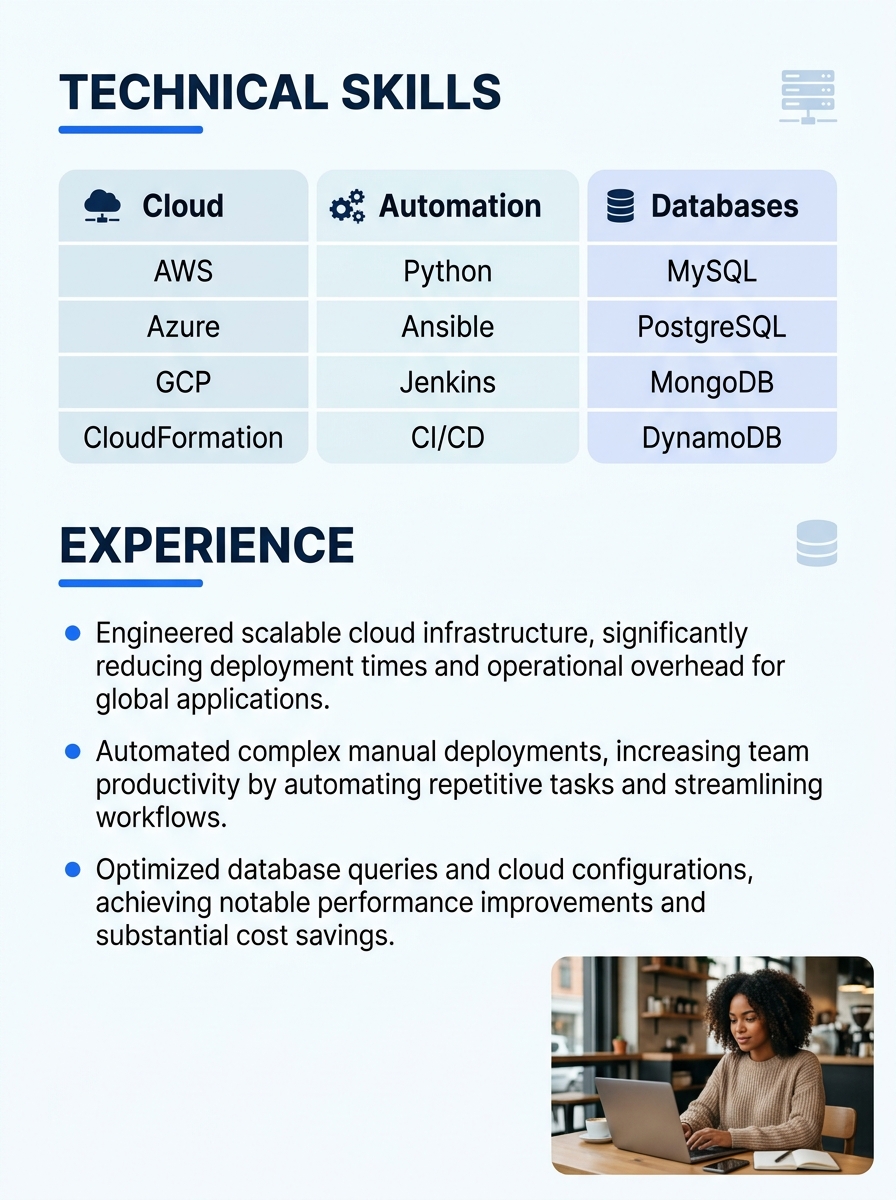
The solution is separation. According to the 2026 ATS optimization guide from The Interview Guys, the recommended strategy is to “create a dedicated Technical Skills section with clear categorization and include keywords naturally in project descriptions.” That word “naturally” is doing heavy lifting. It means your bullet points should contain 1 to 2 recognizable technical terms at most, while your skills section carries the full keyword load.
The Uppl.ai ATS keywords guide recommends aiming for 15 to 25 relevant keywords per resume, noting that this range “demonstrates expertise without triggering keyword stuffing detection.” For an infrastructure professional, that means your Technical Skills section might list AWS, Azure, Terraform, Kubernetes, Ansible, VMware, PostgreSQL, Oracle, Cisco, SD-WAN, Docker, Jenkins, CloudFormation, Datadog, and PagerDuty. Fifteen keywords, all in one clearly labeled section. ATS reads them. The hiring manager’s eyes skip to your experience bullets, which now read clean.
This dual-track approach mirrors the broader principle behind writing resumes that work for both ATS algorithms and human recruiters. The algorithm and the person want different things from your document, and the mistake is trying to serve both in the same paragraph.
Tip: Put your full technical stack (tools, platforms, certifications like CDCP or PMP, cloud services) in a clearly labeled Technical Skills section with subcategories like “Cloud Platforms,” “Automation & IaC,” and “Monitoring.” Keep your experience bullets focused on infrastructure project outcomes: dollars saved, downtime reduced, teams led, deadlines met.
The keyword-in-bullets trap catches experienced infrastructure professionals especially hard. When you’ve spent 18 months on a migration touching Informatica, DataStage, SSIS, and three custom ETL toolsets, your instinct is to name every one. But the hiring manager reading your resume doesn’t know what SSIS stands for, and they aren’t going to Google it during a screening pass. They will, however, understand “automated 40% of manual data processing, freeing the analytics team to deliver reports 3 days faster.” That sentence contains zero tool names and communicates more value than a paragraph of acronyms.
This same principle applies when you’re reframing technical troubleshooting skills or replacing vague duty descriptions with measurable outcomes. The pattern is consistent: lead with the result the business cared about, use numbers to prove the scale, and push the technical vocabulary into sections designed for machine reading.
Where This Leaves Infrastructure Professionals
The claim stands, and the data from hiring research supports it from multiple angles: tool-first resume writing for infrastructure roles actively works against you when a non-technical hiring manager is the first screener. The 20% cost reduction bullet outperforms the detailed Terraform configuration bullet every time, because one communicates value and the other communicates expertise that the reader can’t evaluate.
But here’s where the picture gets more complicated. Some infrastructure roles are screened by technical managers who want to see your Kubernetes experience front and center. The Outcome-Scale-Method framework doesn’t mean you strip your resume of all technical depth. It means you restructure where that depth lives. Your experience bullets tell the business story. Your skills section tells the technical story. Your resume formatting makes both stories easy to find in under 7 seconds.
The 2026 migration landscape has shifted toward refactor and re-architect approaches that align with AI readiness and domain-driven strategy rather than system-based lift-and-shift. That shift actually makes the translation argument stronger, because refactoring is inherently about business alignment, and your resume should reflect that. “Redesigned legacy data architecture to support real-time ML model training, reducing prediction latency from 12 hours to 8 minutes” is a sentence that makes sense to a CTO, a VP of Engineering, and a non-technical CEO reviewing final candidates. The technical specifics of how you got there belong in the interview, where you can read the room and adjust your vocabulary in real time.
Writing ATS-friendly technical resumes that also read well for non-technical audiences isn’t a contradiction. It’s a formatting decision. Keep the two audiences in separate lanes on the same page, and both get what they need.