
 4.9
4.9 4.5
4.5AI resume builders pass automated screening at dramatically higher rates than human-written resumes, with University of Maryland and Ohio State University researchers finding AI-written versions up to 82% more likely to clear ATS filters. But 33.5% of hiring managers say they can spot AI-generated resumes in under 20 seconds, often rejecting them for sounding generic. The best approach depends on where you are in your career and what’s actually blocking your progress.
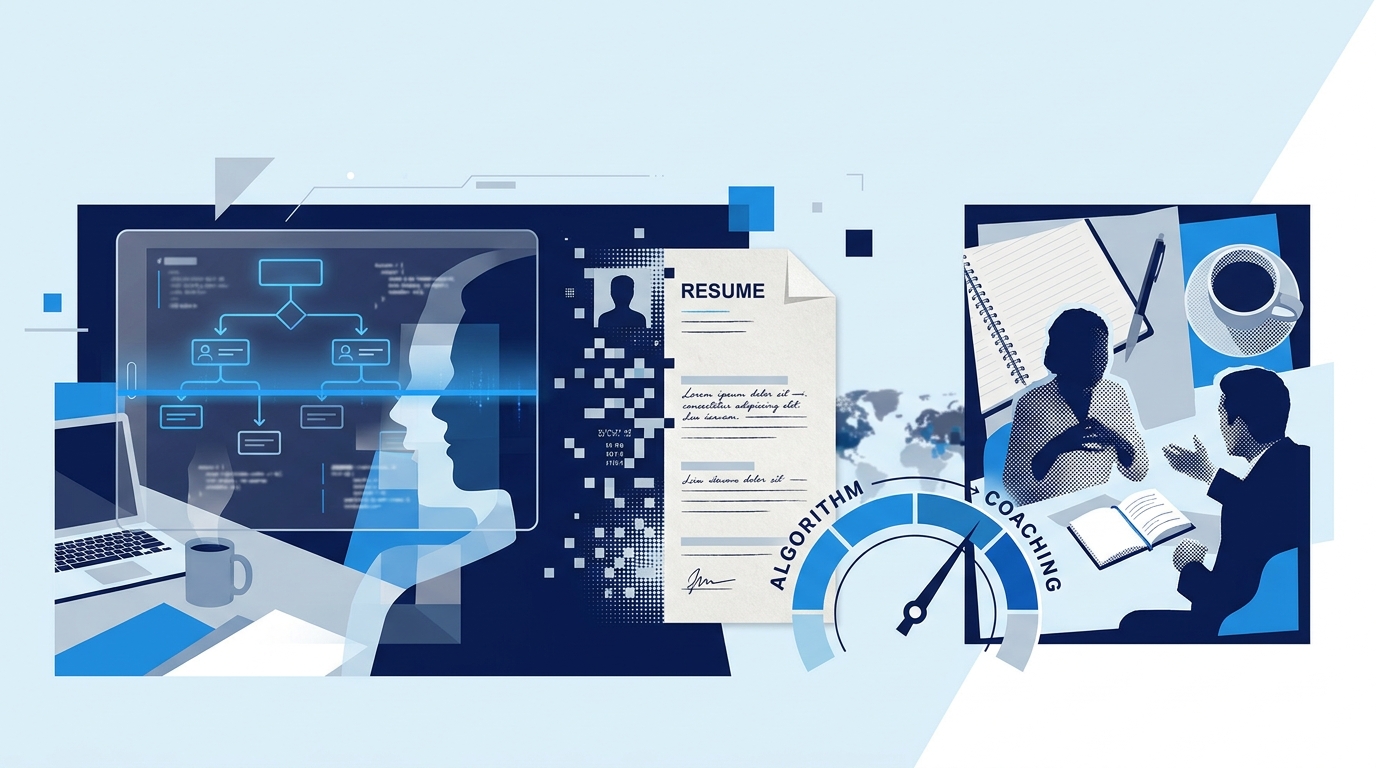
TL;DR: AI builders excel at ATS compliance and speed. Human coaches excel at strategy, positioning, and authenticity. The right choice depends on whether your problem is getting past the algorithm or getting past the interviewer—and for many job seekers, those are two separate problems requiring both.
The tension between resume optimization vs. authenticity has become the defining challenge of the 2026 job market. Up to 75% of resumes get rejected by ATS before a human ever reads them, according to National Search Group’s analysis of AI-friendly resume optimization. About two-thirds of job seekers now use AI at some stage of their search. But the tools you choose, and the order you use them, determine whether you land interviews or disappear into the algorithmic void.
This article breaks down three approaches: going all-in on AI builders, working exclusively with a human career coach, or combining both. Each has specific strengths, blind spots, and cost profiles worth examining before you spend a dollar.
What AI Resume Builders Do Well (And Where They Fail)
AI resume builders solve one problem exceptionally well: getting your resume past automated screening systems. Platforms like Rezi, Jobscan, and Kickresume parse individual job descriptions, extract required keywords, and rewrite your content to match. In 2026 testing, tools using job-description-specific optimization achieved ATS pass rates of 86% or higher, while generic template builders scored between 61% and 75%.
The speed advantage is real. Where a human writer takes days or weeks to deliver a polished draft, an AI builder generates a targeted version in minutes. For job seekers applying to 15 or 20 positions per week, that throughput matters. And the cost difference is stark: most AI builders charge $5 to $30 per month, compared to $200 to $500+ for a single session with a certified resume writer.
But AI resume builder limitations surface quickly once you move past keyword matching. Paula Mathias-Fryer, senior director at SLO Partners and author, warned in her Dice.com interview: “Never copy and paste directly from AI to create your resume.” The output makes your resume look like everyone else’s and raises concerns about authenticity with hiring managers.
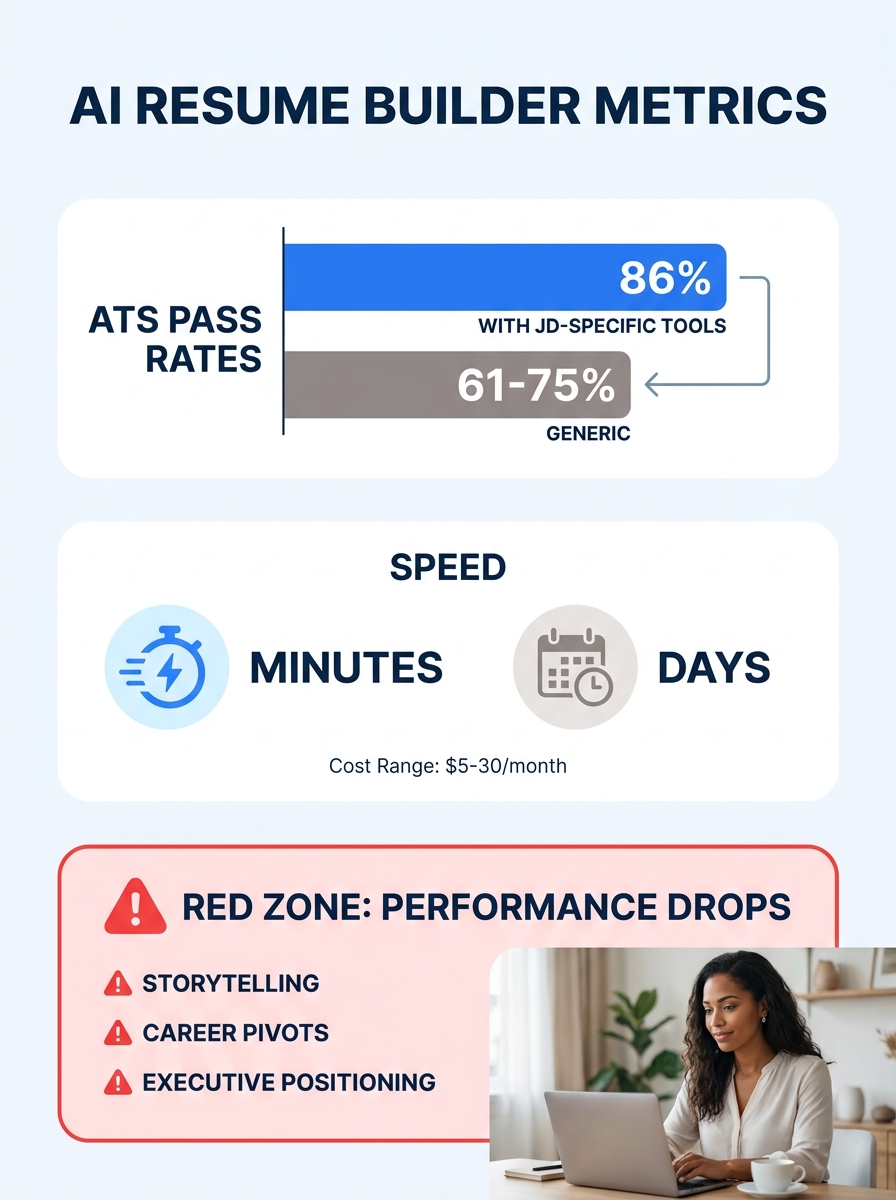
The ATS optimization downsides become clearest in three scenarios:
- Career pivots. AI tools rewrite what you give them. They don’t know how to reframe a supply chain manager’s experience for a product management role. The algorithm matches keywords; it doesn’t construct a narrative about transferable skills. If you’re navigating this kind of transition, the career coaching alignment gap between your background and your target role is where AI falls flat.
- Non-linear career histories. Gaps, contract work, lateral moves. AI handles these by ignoring them or smoothing them into generic language. A human reader spots the evasion instantly.
- Executive and senior roles. At the director level and above, hiring decisions hinge on leadership philosophy, strategic impact, and organizational influence. No AI builder produces a compelling executive narrative from a list of bullet points. We’ve covered why buzzwords tank senior-level resumes in detail, and AI builders generate exactly the kind of buzzword-heavy copy that triggers that problem.
Where AI Builders Genuinely Shine
For mid-career professionals applying to roles that closely match their existing experience, AI builders are the right first step. They ensure formatting consistency, catch ATS-breaking errors like inconsistent date formats, and align your language with the job description’s terminology. If you’re evaluating options, our resume builder reviews compare the major platforms on exactly these criteria.
Human Career Coaches Fill the Gaps AI Can’t See
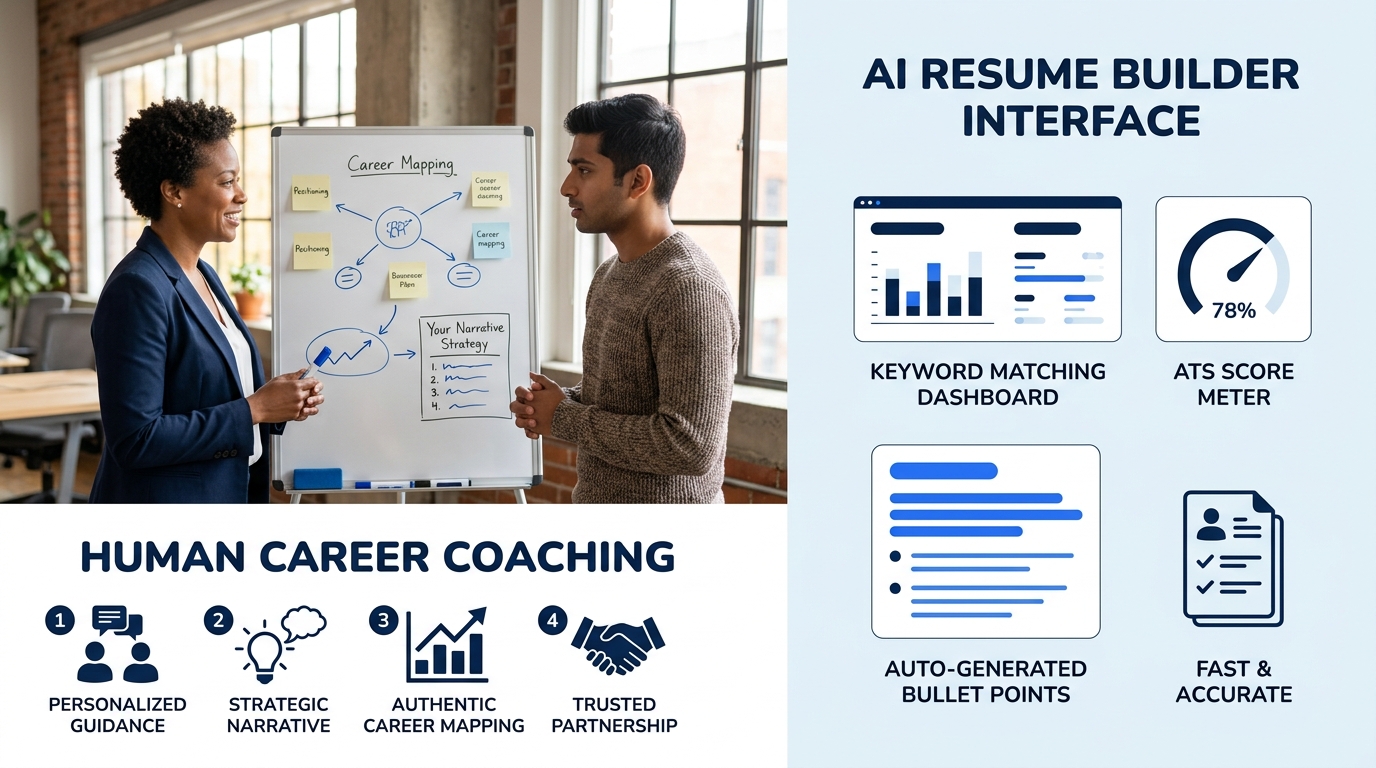
A career coach addresses everything an AI builder can’t touch: direction, positioning, confidence, and the story that connects your past to your future. The International Association of Career Coaches distinguishes the two roles clearly: a coach works across the entire arc of a job search and even helps with career development while you’re employed, while a résumé writer focuses specifically on the application documents.
The value shows up most clearly in conversion rates. Scale Jobs reported in April 2026 that job seekers using human resume writing services are three times more likely to land a job and secure roles 32% faster within 90 days. That gap reflects the coach’s ability to ensure every bullet point is credible, defensible, and strategically aligned with the target role.
Job seekers using human resume writing services are three times more likely to land a job and secure roles 32% faster within 90 days.
But coaches carry real drawbacks. Cost is the obvious one: $150 to $500 per hour for experienced professionals, with full packages running $1,000 to $5,000+. Timeline is another. Expect one to four weeks for a finished resume, plus additional sessions for interview prep and LinkedIn optimization. And quality varies wildly. We’ve written about why even CPRW-certified writers struggle to convert interviews when they don’t understand your specific industry.
The career coaching alignment gap is a genuine risk. A coach who hasn’t worked with engineers displaced by AI-driven layoffs won’t understand the repositioning strategies those candidates need. Ask any prospective coach about their experience with your specific industry, level, and situation before signing a contract.
Where Human Coaches Genuinely Shine
Forbes contributor Julia Korn wrote in September 2025 that the moments where coaching proves irreplaceable involve “empathy, intuition and real-world experience at work—things no algorithm can replicate.” A coach hears the hesitation in your voice when you describe your last role and digs into what’s underneath. That conversation leads to breakthroughs about what you actually want, which reshapes every line of your resume.
For first-time job seekers, coaches provide something equally valuable: the ability to identify transferable skills when you don’t have an established work history. Customer service, active listening, data entry, problem solving. A coach helps you recognize these skills and translate them into concrete value statements that read as genuine accomplishments rather than generic filler.
Combining Both Into a Single Workflow
The consensus among career professionals in 2026 points toward a combined workflow. As Paltron’s career counseling research concluded, AI-powered career coaching brings scalability and data-driven insights, but it does not replace human coaching. It enhances it. And the practical results back this up: LinkedIn job applications increased over 45% year-over-year, largely because AI-assisted applications became the norm. Standing out now requires both algorithmic compliance and human distinction.
Here’s how the hybrid model works in practice:
- Start with a human conversation. Before you open any tool, clarify your target role, your positioning angle, and the three to five accomplishments that define your candidacy. This is strategy work. It takes 60 to 90 minutes with a coach, or several hours of honest self-reflection if you’re doing it alone.
- Draft with AI assistance. Feed your strategic direction into an AI builder. Let it generate keyword-optimized bullet points, suggest ATS-safe formatting, and align your language with target job descriptions. This stage takes minutes, not days.
- Edit with human judgment. Review every AI-generated line against your actual experience. Can you talk about this bullet fluently in an interview? If not, rewrite it. We’ve covered how to audit your resume builder’s AI suggestions for exactly this kind of review.
- Test and iterate. Submit to five to ten positions, track response rates, and adjust. If you’re getting interviews but not offers, the problem is interview prep, not the resume. If you’re getting silence, the resume needs another pass with a different keyword strategy.
Tip: One Reddit user in r/resumes captured the key insight about ATS optimization: “ATS optimization only helps if you’re actually missing the right keywords. If you’re already using the terms from the job description and still getting nothing, the problem is something else.” When keyword alignment isn’t your bottleneck, adding more AI optimization won’t help. That’s when human eyes identify the real gap.
The hybrid approach costs more than AI alone but far less than a full coaching engagement. Budget $10 to $30 per month for the AI tool plus one or two coaching sessions ($300 to $800 total) focused specifically on strategy and positioning. For many job seekers, that combination delivers better results than either approach in isolation.
How to Choose Between These Three
The right tool selection framework depends on three variables: how close your current experience is to your target role, your budget, and what’s actually blocking your progress.
| Factor | AI Builder Alone | Human Coach Alone | Hybrid Approach |
|---|---|---|---|
| Best for | Applying to roles matching current experience | Career transitions, gaps, executive positioning | Mid-career professionals targeting a stretch role |
| ATS pass rate | 86%+ with JD-specific tools | Varies by writer’s ATS knowledge | Highest when AI handles compliance and human handles narrative |
| Cost | $5–$30/month | $200–$5,000+ | $300–$850 total |
| Timeline | Minutes per version | 1–4 weeks | 1–2 weeks |
| Biggest risk | Generic output hiring managers reject (33.5% spot it in 20 seconds) | Coach misaligned with your industry; slow turnaround | Requires your active involvement in editing |
| Interview readiness | Low: you can’t defend AI-written claims you don’t understand | High: coach ensures every bullet is defensible | High, if you do the editing step honestly |
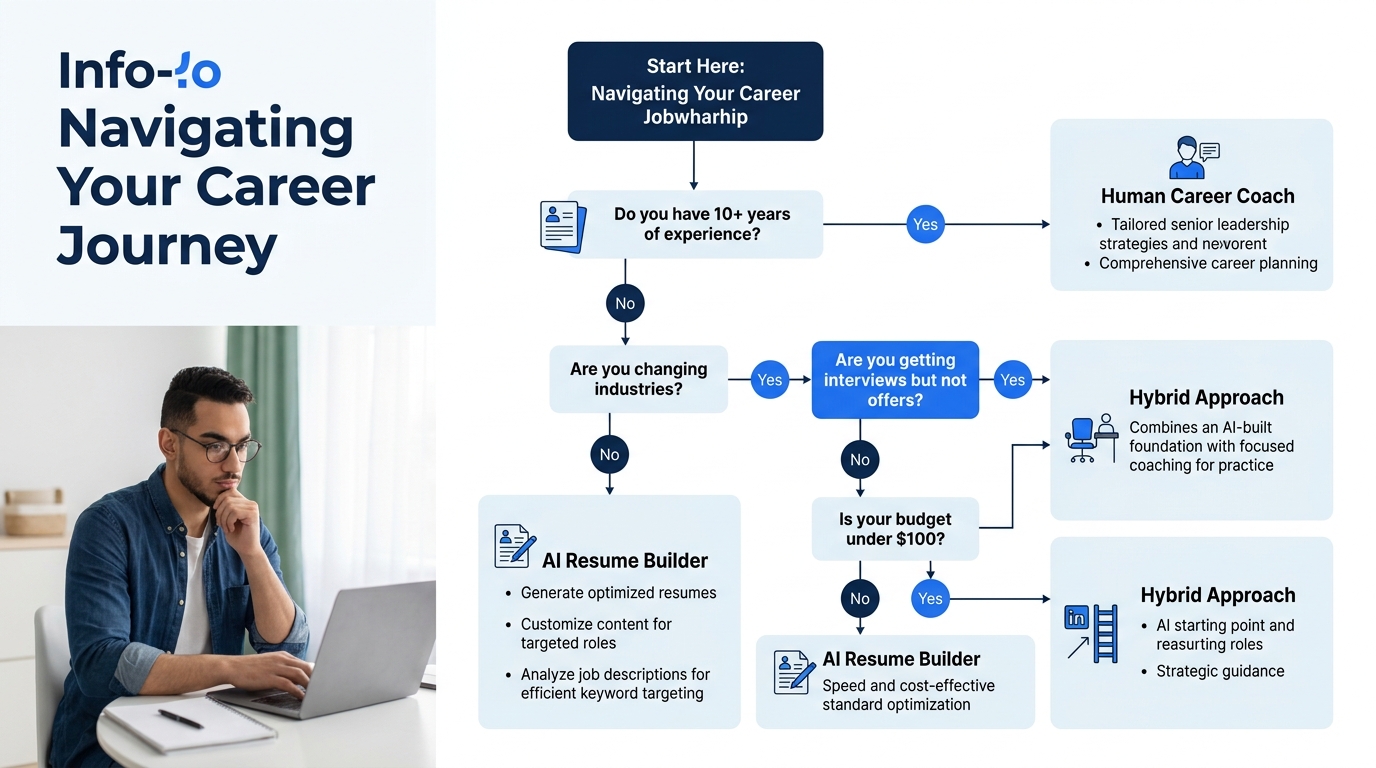
If you’re applying to roles that match your current title and industry, and your budget is tight, an AI builder is a reasonable starting point. Check whether the one-click matching features in your tool are helping or hurting before you rely on them heavily.
If you’re making a significant career change, re-entering the workforce after a gap, or targeting roles two levels above your current position, a human coach provides the strategic depth that no algorithm replicates. The investment pays for itself if it cuts your search from six months to four.
And if you’re somewhere in between, qualified for the role but competing against a flood of AI-optimized applications, the hybrid approach gives you algorithmic compliance and human distinction in the same document. That combination addresses the full pipeline: clearing the ATS filter and then convincing the hiring manager on the other side that you’re worth a conversation. For more guidance on building a job search strategy that holds together from resume to interview, browse our career guides and deep-dives across the full application process. The tool that fixes your specific failure point is the right one. Everything else is noise.