
 4.9
4.9 4.5
4.5Architecture firms run two parallel screening tracks that contradict each other. The first is an Applicant Tracking System that strips visual formatting and scores keyword density. The second is a human reviewer who wants to see built projects rendered in full-color spreads. The document that clears one gate often fails the other.
TL;DR: Architects face a genuine tension between ATS-optimized resumes (plain text, keyword-dense) and portfolio-driven hiring (visual storytelling, design evidence). Three strategies exist: pure ATS resume, visual hybrid, or a two-document split. For most mid-career architects, the two-document approach wins because it respects both gates without compromising either.
Three distinct strategies dominate how architects handle the architecture resume portfolio balance. Each carries real tradeoffs in time, formatting risk, and how effectively it communicates design skill. Here’s how they compare and which one actually fits your situation.
The ATS-Optimized Plain-Text Resume
ATS software parses resumes by identifying standard section headings, extracting keywords, and scoring relevance against a job description. According to ResumeAdapter’s 2026 ATS Optimization Hub, that parsing process covers three distinct layers: formatting compliance (no tables or text boxes), keyword matching, and structural hierarchy. For architects, this creates an immediate problem: the medium erases the message.
Nearly 90% of employers now use AI-driven ATS to filter resumes before a human sees them. At large firms like Gensler (6,000+ employees across 53 offices), HOK, or Perkins&Will, your application enters a database alongside hundreds of candidates. The system scans for terms like “Revit,” “AutoCAD,” “sustainable design,” “LEED AP,” “project management,” and “construction documents.” Per VisualCV’s architecture resume keyword guide, highlighting skills in architectural design, project management, and sustainable practices is what aligns your resume with ATS scoring algorithms. A resume built in InDesign with custom fonts, embedded images, and multi-column layouts often gets garbled or rejected outright because the parser can’t read the file structure.
The plain-text resume passes ATS filters reliably. You list your licensure status, software proficiency (Revit, Rhino, Grasshopper, Enscape, SketchUp), project types, and square footage managed. The tradeoff: a plain-text resume tells a hiring manager nothing about your design sensibility. It communicates competence without character. For an architect, that’s like submitting a building’s spec sheet without a single rendering. The ATS optimization vs design showcase tension is starkest with this approach. You clear the digital gate, but the human on the other side has zero visual evidence you can design.
Best fit: Large corporate firms (500+ employees) with formal HR pipelines. Entry-level candidates applying to internships at firms that specify “submit resume only.” Government or institutional architecture positions where ATS compliance is non-negotiable.
The Visual Portfolio-Resume Hybrid
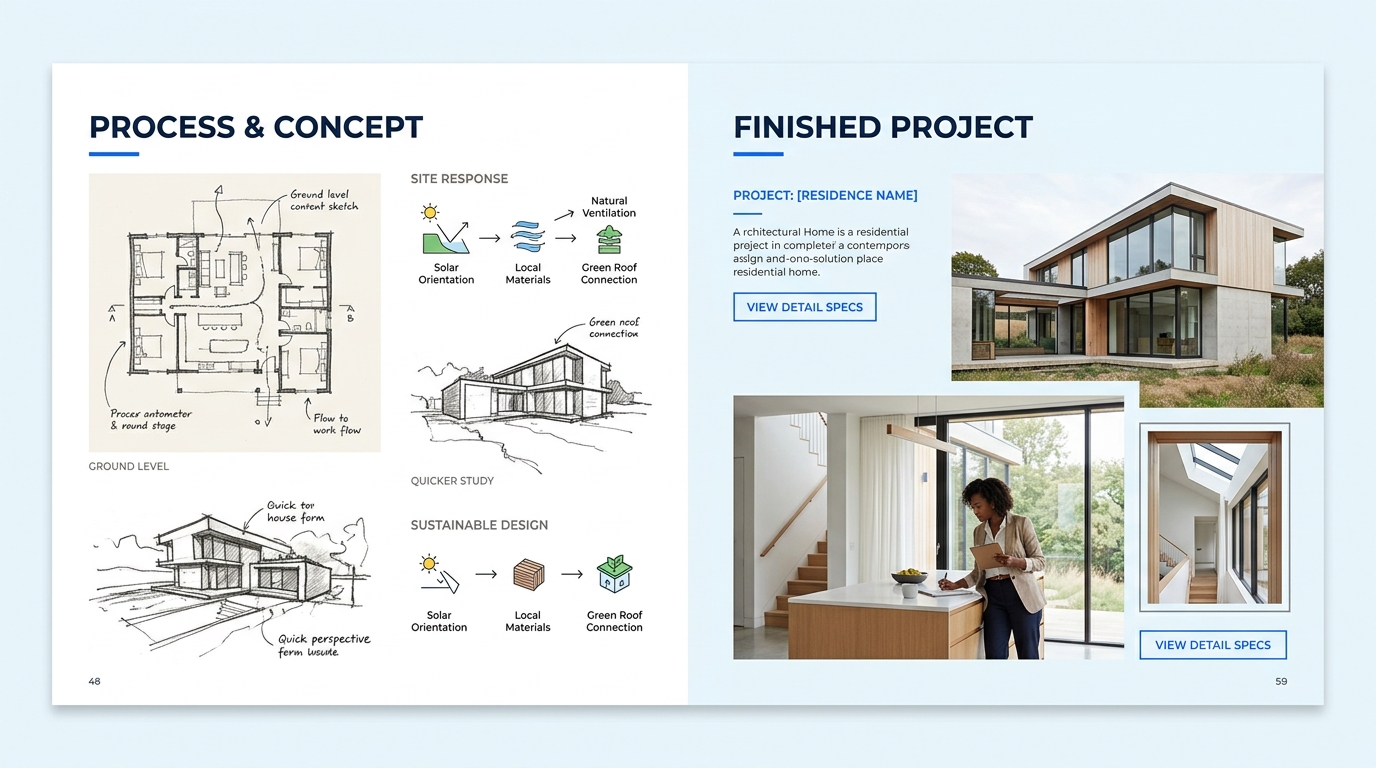
The opposite extreme merges everything into a single designed document, typically 8 to 20 pages, combining biographical information, project images, process diagrams, and work history into one PDF. This is the visual resume for architects in its purest form.
ArchDaily’s curated collection of 17 architecture portfolio designs shows what strong versions look like: clean typography, curated project spreads with 3 to 5 images per project, brief written narratives explaining design decisions, and a consistent visual identity throughout. The best portfolios function as design projects themselves.
Why does the hybrid document appeal to design studios? Because architecture hiring demands proof of spatial thinking that words alone can’t deliver. Archisoup’s professional portfolio guide states that “firms want to see that a candidate has strong communication skills” and “the ability to explain their design decisions to clients, contractors, and other team members.” A well-crafted hybrid document demonstrates exactly that through layout choices, image selection, and information hierarchy.
According to the Chipman Design hiring guide, “hiring managers often spend less than 2 minutes skimming a portfolio on the first pass,” which means your hybrid document needs clear section headers and a table of contents. Two minutes is generous compared to the 6 to 7 seconds that recruiters in other industries typically spend on a standard resume. Architecture hiring managers give more time because visual evaluation is literally part of their job description.
The tradeoff is brutal on the ATS side. A designed PDF with embedded fonts, image layers, and custom grids will score poorly or fail entirely when processed through applicant tracking software. A 15 MB portfolio PDF also exceeds the 10 to 15 MB file size limits that many application systems enforce. If you submit this document through an online portal at a firm that uses ATS screening, your application may never reach a human reviewer.
Best fit: Boutique firms (under 50 employees) where you’re emailing a principal directly. Referral-based applications where someone has already flagged your name internally. Design-focused studios (BIG, Studio Gang, MASS Design Group) where visual storytelling carries as much weight as technical credentials.
The Two-Document Strategy
An Archinect forum discussion on combining versus separating these materials reveals the standard toolkit that experienced architects maintain. One contributor described the full set: “Typically you need two portfolios (design oriented and technically oriented), one website, one business card and up to 4 resume versions in a typical job search.” That’s up to 8 distinct application assets for a single architect.
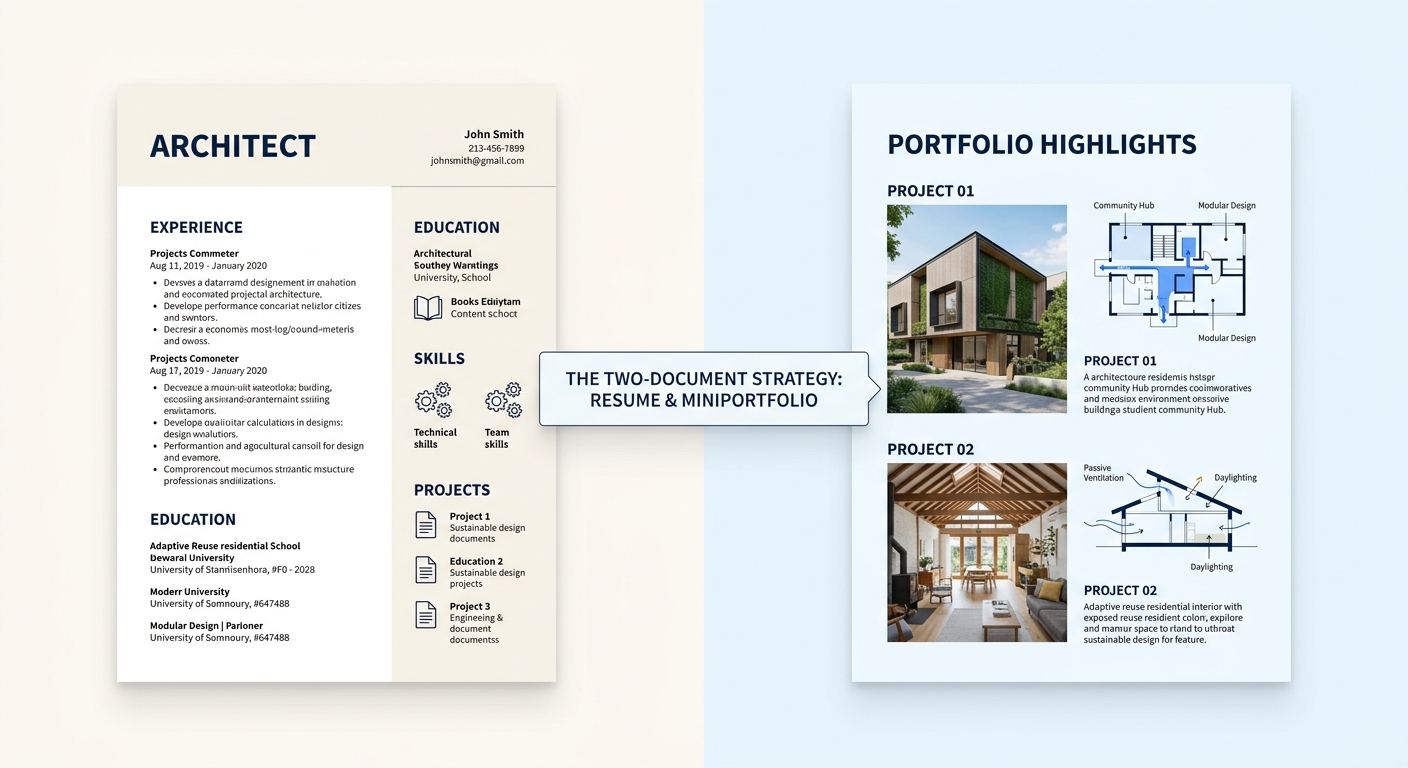
The simplified version splits your materials into two core pieces. Document one is a clean, ATS-friendly, single-page resume in Word or plain PDF format. It contains your licensure info, software skills, education, and work history with quantified accomplishments (square footage designed, project budgets managed, team sizes led, construction timelines met). Document two is a curated 2 to 5 page mini-portfolio in a designed PDF, kept under 10 MB.
This separation solves the paradox directly. The resume passes automated screening. The portfolio satisfies the human reviewer’s need to evaluate design skill. You submit the resume through the online portal and email the portfolio separately, or attach both when the application system allows multiple uploads.
The Reddit architecture community surfaces a related insight: for small firms specifically, a video cover letter alongside standard written materials generates consistent positive feedback from hiring managers who “really appreciate the effort and personalisation.” That’s a third document layer, one that differentiates aggressively at boutique studios where the principal reviews every application personally.
If your resume reads like it was polished by AI and lacks authentic voice, a portfolio with hand sketches, physical model photos, and process documentation creates a powerful counterbalance. The visual work proves human thinking in ways that text alone cannot.
Career stage shapes which document carries more weight. Architects with 3 to 10 years of experience need to clearly state their specific role in team projects across both documents, since firm leaders want to know whether you led design development or handled construction administration. Architects with 10+ years should weight the portfolio toward built work, client outcomes, and specialized expertise. For entry-level candidates, the portfolio does most of the heavy lifting because the resume simply lacks enough professional content to stand alone.
Best fit: The widest range of scenarios. Mid-career architects (5 to 15 years) applying across firm sizes. Anyone navigating the architect hiring process at firms they haven’t researched enough to know whether ATS screening is active. Job searches spanning both corporate and boutique firms simultaneously.
Tip: Not sure whether a firm uses ATS? Check the application portal. Systems like Greenhouse, Lever, Workday, and iCIMS all process uploaded files through parsing algorithms. If the portal asks you to “upload your resume” and then auto-populates form fields with your extracted text, ATS is active. Submit the plain resume there and send the portfolio separately by email.
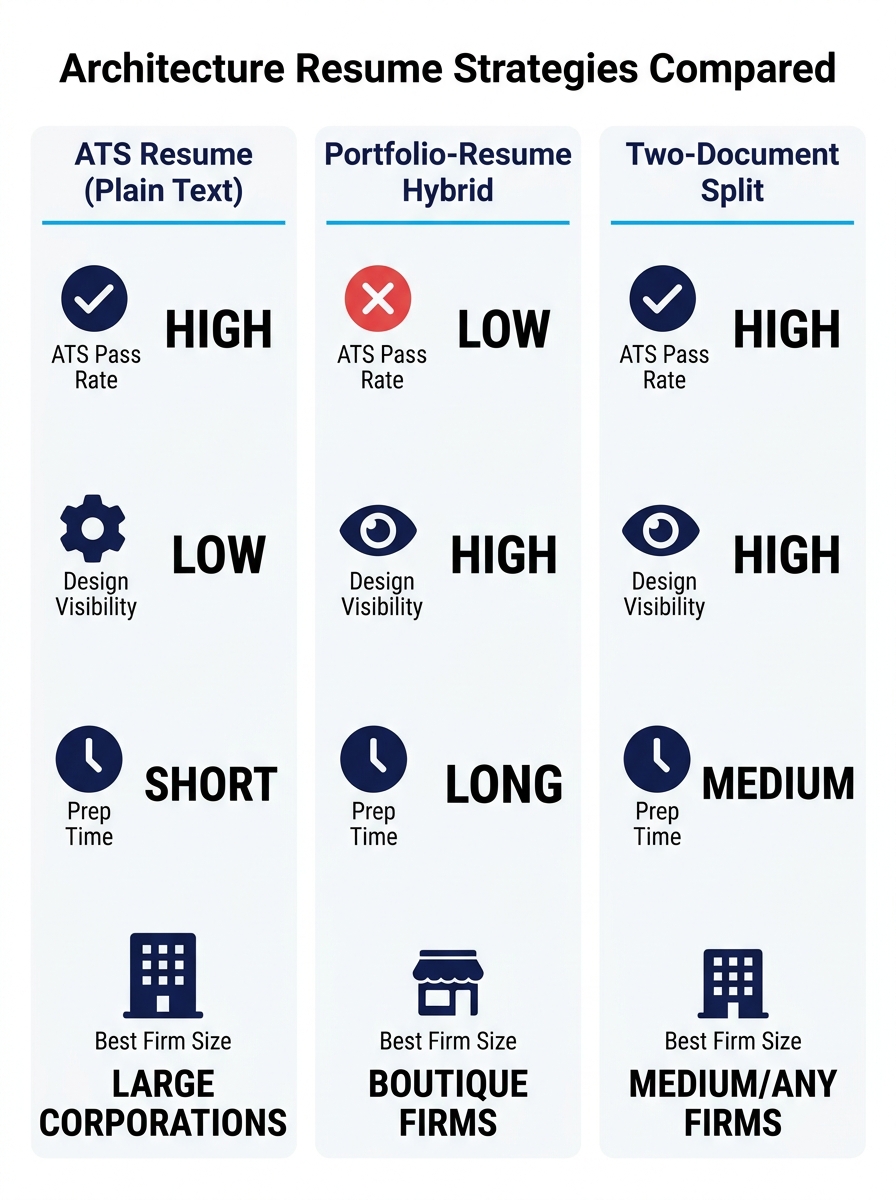
| Criteria | ATS Plain-Text Resume | Visual Portfolio-Hybrid | Two-Document Strategy |
|---|---|---|---|
| ATS pass rate | High (95%+) | Low (under 30%) | High for resume component |
| Design skill visibility | None | Strong | Strong via separate portfolio |
| Prep time per application | 30 to 45 minutes | 2 to 4 hours | 1 to 2 hours |
| Ideal firm size | 500+ employees | Under 50 employees | Any size |
| File size risk | Under 1 MB | 10 to 20 MB (often rejected) | Resume under 1 MB, portfolio under 10 MB |
| Career stage | Entry-level, corporate | Senior, design-focused | All stages |
How to Choose Between These Three
The answer depends on three variables: firm size, how you’re reaching the hiring manager, and where you are in your career.
If you’re applying cold to firms with more than 100 employees, the ATS-friendly resume is non-negotiable. Pair it with a portfolio link or attachment whenever the system allows it. Treating the formatting of that resume as a serious design constraint will keep it readable for the human reviewer who eventually sees it past the filters.
If you have a direct referral or a personal relationship with a firm principal, the visual hybrid can work. The referral bypasses automated screening, and the designed document does the selling. But maintain a plain-text version anyway, because HR departments often still process your materials through their standard pipeline after the principal forwards your name.
Stop trying to solve both problems in one document. Give each screening gate exactly what it needs.
For everyone else, the two-document strategy is the honest recommendation. It respects both screening gates without forcing you to compromise on either. The architecture resume portfolio balance is a real constraint with real consequences. When job searches now average 108 days to first offer, you don’t have the runway to guess which format a particular firm prefers.
If you’re struggling to translate project experience into the kind of quantified impact statements that ATS and humans both respond to, working with one of the best resume writing services experienced in architecture and design can close that gap. The resume half of your two-document toolkit needs to be as sharp as your portfolio spreads. Keep both documents updated, tailor the resume keywords to each job posting, and curate the portfolio to match the target firm’s project types. The paradox doesn’t go away, but a two-document approach turns it into a manageable workflow instead of a guessing game.