

 4.9
4.9 4.5
4.5The standard LinkedIn profile optimization advice backfires for professionals with 8 to 15 years of experience. Generic checklists treat a mid-career marketing director and a recent graduate identically, producing profiles that read the same way and rank poorly because LinkedIn’s 2026 algorithm penalizes vague, undifferentiated keyword placement with lower search visibility.
TL;DR: Mid-career LinkedIn profiles fail when they follow the same checklist as everyone else. The three fixes that actually move recruiter visibility: a 220-character headline naming a specific outcome, an About section written in first person with an “I help X do Y” structure, and a skills list pruned to 10-20 entries matching the role you want. Profiles reaching All-Star status appear in 40x more searches than incomplete ones.
A mid-career LinkedIn checklist needs to account for the fact that you have too much experience, not too little. The temptation is to list everything. That instinct produces a profile so broad that LinkedIn’s algorithm can’t figure out which searches to surface you for, and recruiters scanning profiles in an average of 6 seconds can’t figure out what you actually do well. The three sections where mid-career professionals lose the most ground are the headline, the About section, and the skills list. Each one has a specific failure mode that generic optimization advice makes worse.
The 220-Character LinkedIn Headline That 86% of Profiles Get Wrong
The LinkedIn headline is the single highest-impact field on your profile because it appears in every search result, every comment you leave, every connection request you send, and every message notification. LinkedIn gives you 220 characters for it. The default fills it with your current job title and company name. For a mid-career professional, that default is a waste of roughly 170 characters.
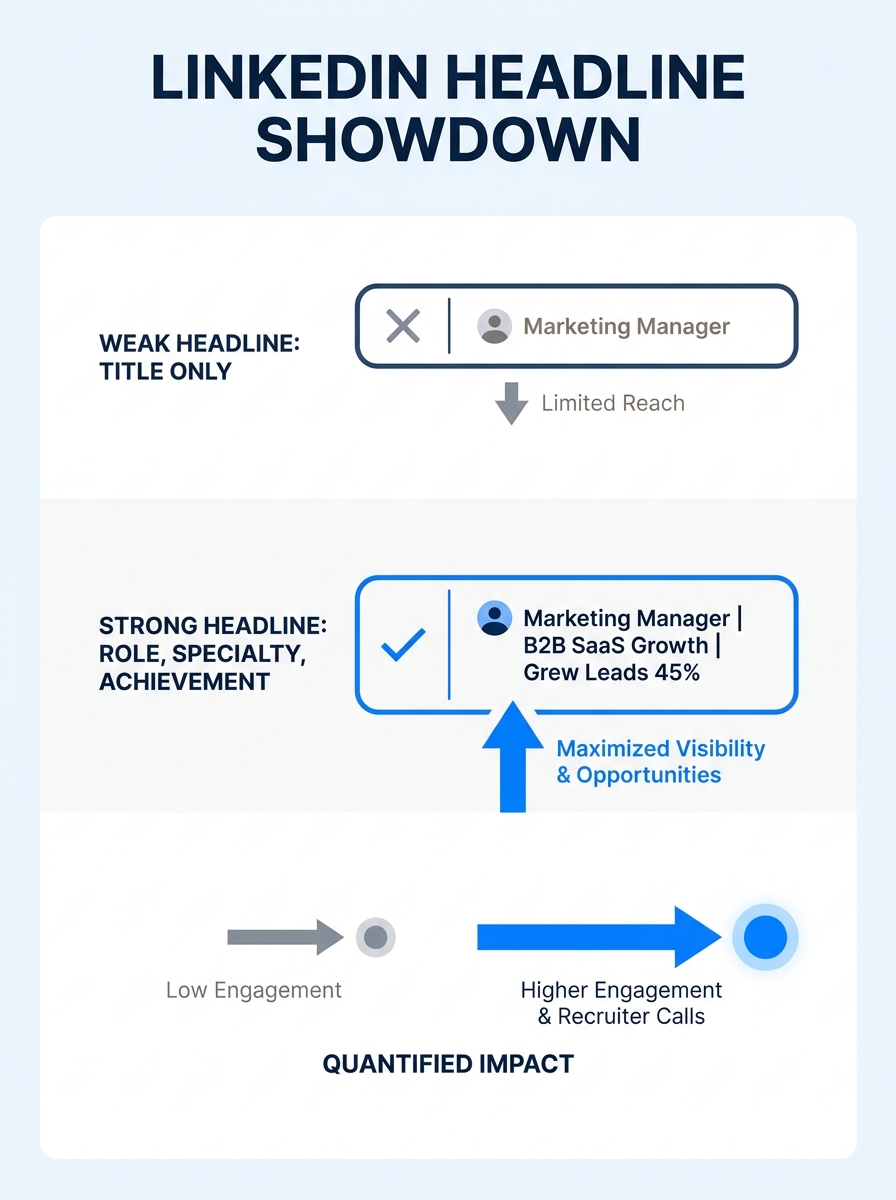
According to Jobscan’s 2026 analysis, a strong headline tells a recruiter three things: who you are (your role), what you do (your specialty), and what value you bring (your measurable impact). Profiles with optimized headlines receive 40% more profile views than those using the default job-title-only format. And profiles that reach completion (what LinkedIn calls All-Star status) appear in 40x more searches than incomplete ones. The headline is the first field recruiters evaluate when deciding whether to click.
Here’s what a bad mid-career headline looks like: “Senior Manager at Acme Corp.” That’s 30 characters. You’ve left 190 on the table and told a recruiter nothing about your specialty, your industry vertical, or any result you’ve produced.
A better version: “Senior Operations Manager | Supply Chain Optimization for CPG Brands | Reduced Fulfillment Costs 22% Across 14 Distribution Centers.” That’s specific. It names a vertical (CPG), a function (supply chain), and a quantified result (22% cost reduction across 14 sites). The algorithm can match it to relevant recruiter searches, and a human can understand what you’re good at in under 3 seconds.
Tip: If you’re exploring a career shift, your headline should reflect where you’re going, not where you’ve been. As The Interview Guys note in their LinkedIn SEO guide, “Career changers who optimize proactively get found.” Join groups in your target industry and update your headline to signal the role you want, so the algorithm stops pigeonholing you based on your history.
For mid-career professionals who have held multiple roles, resist the urge to list all of them in the headline. Pick the one function that represents your strongest positioning for the next role. If you need help quantifying achievements for non-technical roles, the same principles that work for resume bullets apply to your LinkedIn headline.
Why First-Person LinkedIn Summaries Outperform Corporate Jargon
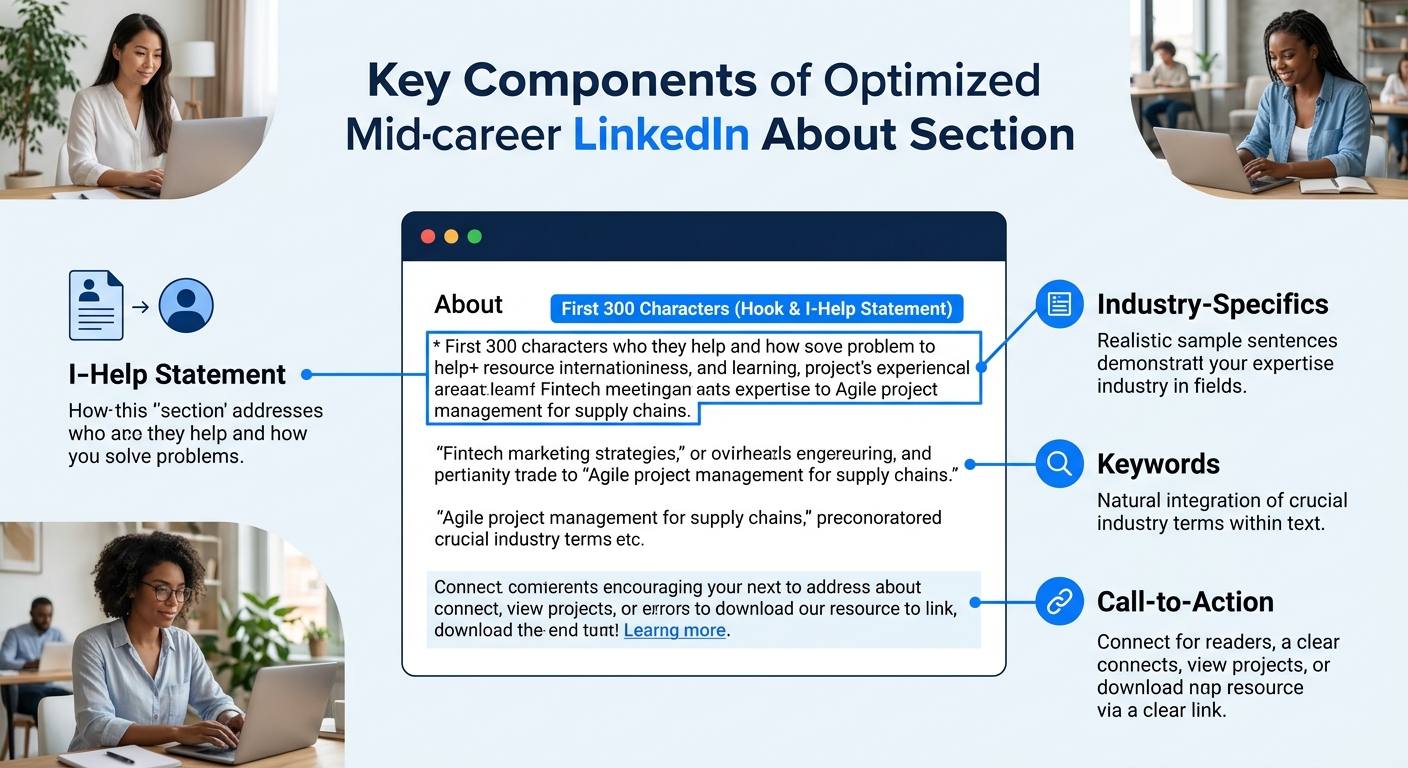
The LinkedIn summary (the About section) gives you 2,600 characters. The first 300 characters are visible before a reader clicks “see more,” which means those opening lines carry disproportionate weight. LinkedIn’s 2026 algorithm evaluates the About section for semantic relevance to recruiter search queries, so keyword placement matters here. But the way mid-career professionals typically write this section destroys both readability and search performance.
LinkedIn’s own Talent Blog addressed this directly: “Too many profiles read like: ‘Strategic, results-oriented professional with a proven track record of delivering results and a demonstrated history working in the XYZ industry.’ What does that even mean? Think about how you would speak to a new contact at a conference and write that way.” That advice comes from LinkedIn itself, and most mid-career profiles still ignore it.
The failure mode is predictable. After a decade in an industry, professionals accumulate a vocabulary of corporate abstractions. They write summaries full of phrases like “cross-functional leadership” and “stakeholder alignment” and “driving organizational transformation.” These phrases appear on thousands of profiles, which means they carry almost zero differentiation signal for the algorithm and zero persuasive power for a human reader.
The fix is structural. Write your LinkedIn summary in first person. Open with an “I help [specific audience] [achieve specific outcome]” statement. HubSpot’s LinkedIn guide recommends including your years of experience, your area of expertise, the types of organizations you’ve worked with, and what you’re most known for professionally. All of that belongs in the first 300 characters.
Here’s a concrete before-and-after. Before: “Results-driven finance professional with 12+ years of progressive experience in financial planning, analysis, and strategic decision-making across diverse industries.” After: “I help SaaS companies between Series B and IPO build financial models that hold up during due diligence. 12 years in FP&A, with three successful exits where my forecasting accuracy stayed within 4% of actuals.”
The second version names a buyer (SaaS companies at a specific stage), a deliverable (financial models for due diligence), and a proof point (4% forecasting accuracy across three exits). The algorithm can match it to relevant searches. A recruiter can decide in 6 seconds whether this person fits an open role.
After a decade in an industry, professionals accumulate a vocabulary of corporate abstractions. They write summaries full of phrases like “cross-functional leadership” and “stakeholder alignment.” These phrases appear on thousands of profiles, carrying almost zero differentiation signal.
If you’ve been struggling with buzzwords in your executive summary, the same problem applies on LinkedIn but with higher stakes, because recruiters see your LinkedIn summary before they ever see your resume. The professionals who are trapped by their own competence often have the hardest time writing a specific summary, precisely because they can do many things well and don’t want to narrow their positioning. Narrowing is the point. A profile that speaks to everyone speaks to no one in the algorithm’s ranking.
The Skills Section Is a Ranking Signal, Not a Résumé Dump
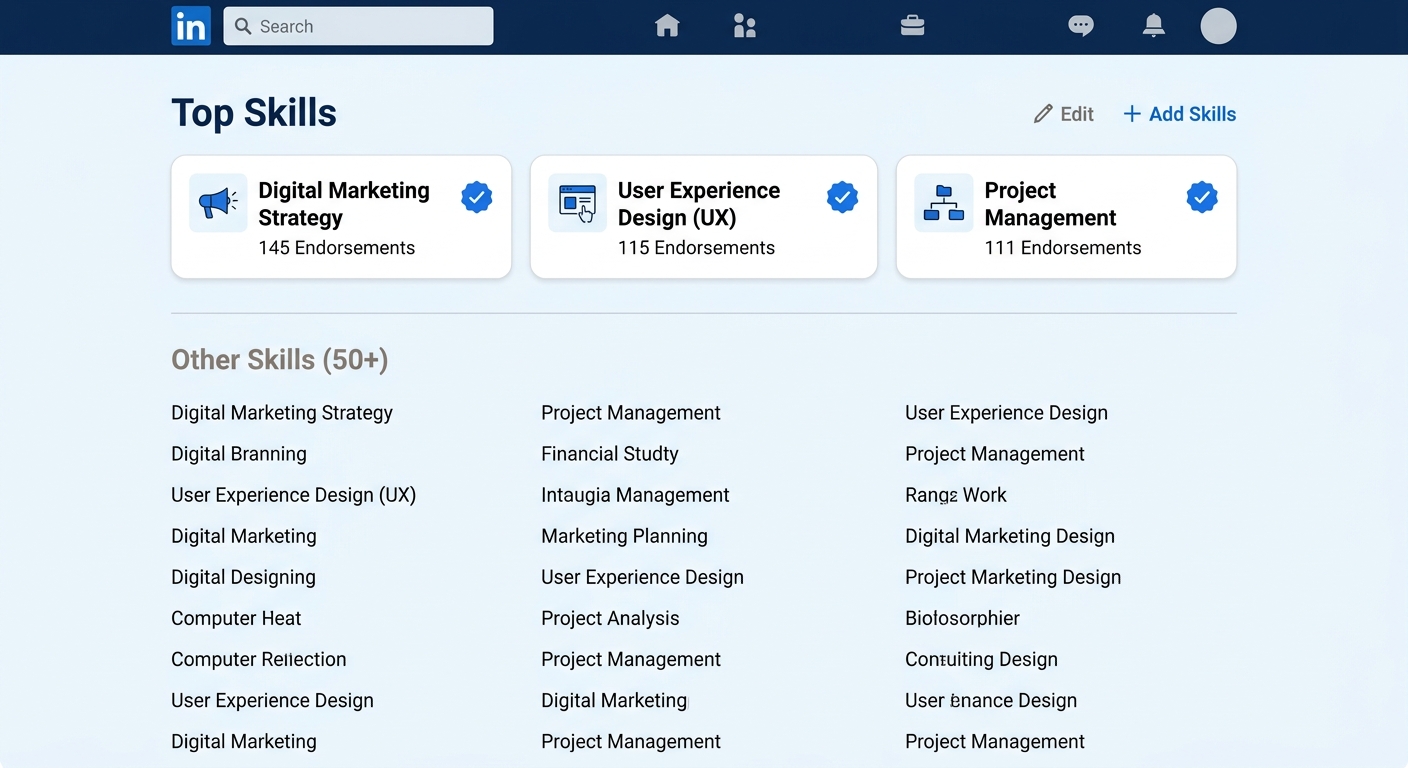
LinkedIn allows you to list up to 50 skills. The mid-career mistake is treating this like a completeness exercise, adding every skill you’ve ever used, from “Microsoft Word” to “Strategic Planning” to “Team Building.” The result is a diluted signal that confuses the algorithm about your core competencies.
The data on this is clear. Profiles with verified skill badges (earned through LinkedIn’s skill assessments) rank 30% higher in recruiter searches for that specific skill. And the recommendation from multiple LinkedIn optimization guides converges on the same number: 10 to 20 relevant skills, not 50. As ResumeVera’s 2026 best practices guide puts it, “Listing ‘Microsoft Word’ as a skill in 2026 signals you don’t know how to prioritize.”
For mid-career professionals, the skills section has a specific tactical purpose: it should reflect the role you want next, not a catalog of everything you’ve done. Pin your top 3 skills to match the target position. If you’re a product manager eyeing VP-level roles, pin skills like “Product Strategy,” “P&L Management,” and “Go-to-Market Execution” rather than “Agile Methodology” or “JIRA.” The pinned skills appear first and carry more algorithmic weight.
| Skills Strategy | What It Looks Like | Effect on Search Ranking |
|---|---|---|
| Default (50 skills, unprioritized) | Every skill from every role, including outdated tools | Diluted relevance, lower match scores |
| Pruned (10-20 skills, targeted) | Only skills relevant to target role, outdated entries removed | Higher relevance per skill, better matching |
| Pruned + Verified (10-20 skills with badges) | Targeted skills with LinkedIn assessment badges | 30% higher ranking in recruiter searches per verified skill |
| Pruned + Verified + Endorsed (10-20 with 5+ endorsements each) | Targeted, badge-verified, peer-endorsed skills | Highest visibility, strongest social proof signal |
The endorsement layer matters too. Five endorsements per skill is the threshold where the algorithm starts treating the skill as validated. Ask former colleagues to endorse your top 3 pinned skills specifically, not generically. And reciprocate with endorsements for their key skills, which often prompts return endorsements.
Recommendations round out the social proof picture. Two strong recommendations, one from a manager and one from a peer or client, provide validation that no amount of self-written copy can match. Profiles with photos receive 14 to 21 times more views than those without, and profiles with recommendations convert those views into recruiter outreach at significantly higher rates. If you’ve been aligning your resume with coaching feedback, your LinkedIn profile needs the same consistency: the story your recommendations tell should match the positioning in your headline and summary.
Where This Leaves the Mid-Career LinkedIn Checklist
The conventional wisdom about LinkedIn profile optimization (fill out every section, add as many keywords as possible, turn on Open to Work) produces adequate results for entry-level candidates building a profile from scratch. For mid-career professionals, that same advice creates noise. The algorithm rewards specificity over completeness. A profile with 15 precisely chosen skills outperforms one with 50 generic entries. A headline with a quantified result outperforms one with a job title alone by 40% in profile views. A first-person summary that names a specific buyer and a specific deliverable outperforms a third-person corporate biography in both algorithmic matching and human decision-making.
The uncomfortable part of this checklist is what it asks you to remove. Pruning skills, narrowing your headline to one function, writing a summary that excludes half your experience: these feel like you’re leaving value on the table. You aren’t. LinkedIn’s search algorithm, like every search system, performs better when the signal is concentrated. A recruiter spending 6 seconds on your profile needs clarity, not breadth. The mid-career LinkedIn profile that gets found is the one that makes a single, specific, provable claim about what you do well. Everything else is decoration.