


 4.9
4.9 4.5
4.5Describing the processes you oversaw, rather than the outcomes those processes produced, is the most reliable way to sink a post-layoff operations manager resume. The fix takes an afternoon: replace every duty-based bullet with a specific number that proves something changed because you were in the room.
TL;DR: Operations managers who rewrite their resumes around measurable process outcomes (cost reductions, efficiency percentages, headcount impact) instead of responsibility descriptions see dramatically higher interview rates. This resume results case study walks through the before-and-after rewrite logic, the tailoring math behind fast callbacks, and the gap-handling language that turned a stalled search into three interviews in ten days.
Every Duty Bullet Is a Missed Opportunity
Why does a process improvement resume outperform a duty-based one? Because hiring managers read for proof of impact, and a sentence like “oversaw warehouse logistics for a team of 40” offers zero proof of anything except presence. The Muse’s resume advice team frames the distinction bluntly: “planned events” is a job duty, while “raised $100,000 by selling out tickets to a 200-person charity event” is an accomplishment. That gap between duty and accomplishment is where callbacks live or die.
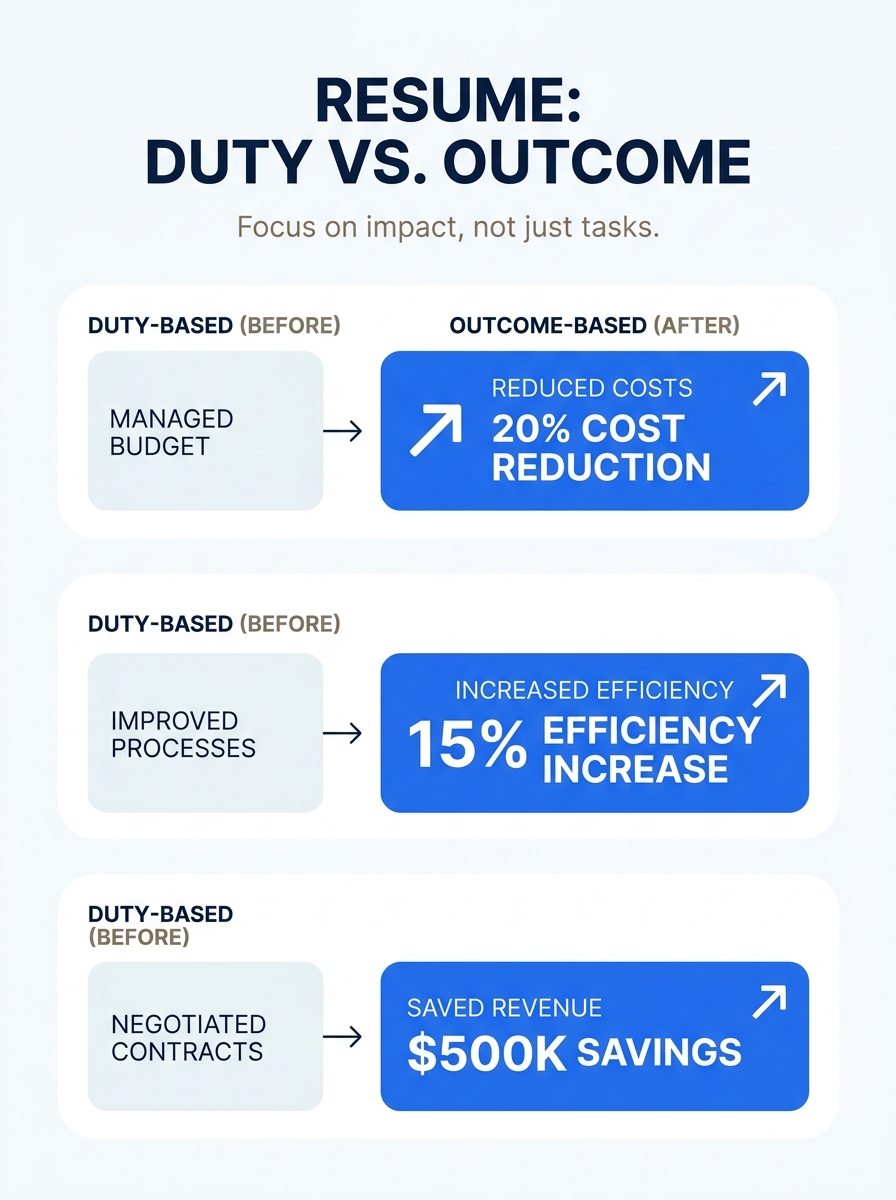
The operations manager resume that triggered three interviews in ten days had a revealing resume before and after. The original version listed responsibilities like “managed vendor relationships” and “oversaw daily production scheduling.” The rewritten version replaced those lines with outcome-driven bullets. Here’s how the translation worked in practice:
Before: Managed supply chain processes and vendor contracts across 3 distribution centers.
After: Reduced inventory costs by 20% through supply chain process optimization across 3 distribution centers, saving $340K annually.
Before: Responsible for production floor efficiency and team scheduling.
After: Increased production efficiency by 15%, resulting in $500K annual savings while maintaining the same headcount of 50 employees.
These aren’t cosmetic edits. They’re structural rewrites that answer a different question entirely. The first version answers “What were you in charge of?” The second answers “What got better because you were there?” According to Resume Worded’s 2026 operations manager examples, metrics like these (cost reductions, efficiency percentages, team size) are the three data points hiring managers scan for within the first 6 seconds of reviewing an operations manager resume.
If you want a deeper system for turning vague responsibilities into numbers that land, our metrics framework for non-technical roles walks through the conversion process step by step.
The Three-Number Test for Every Bullet
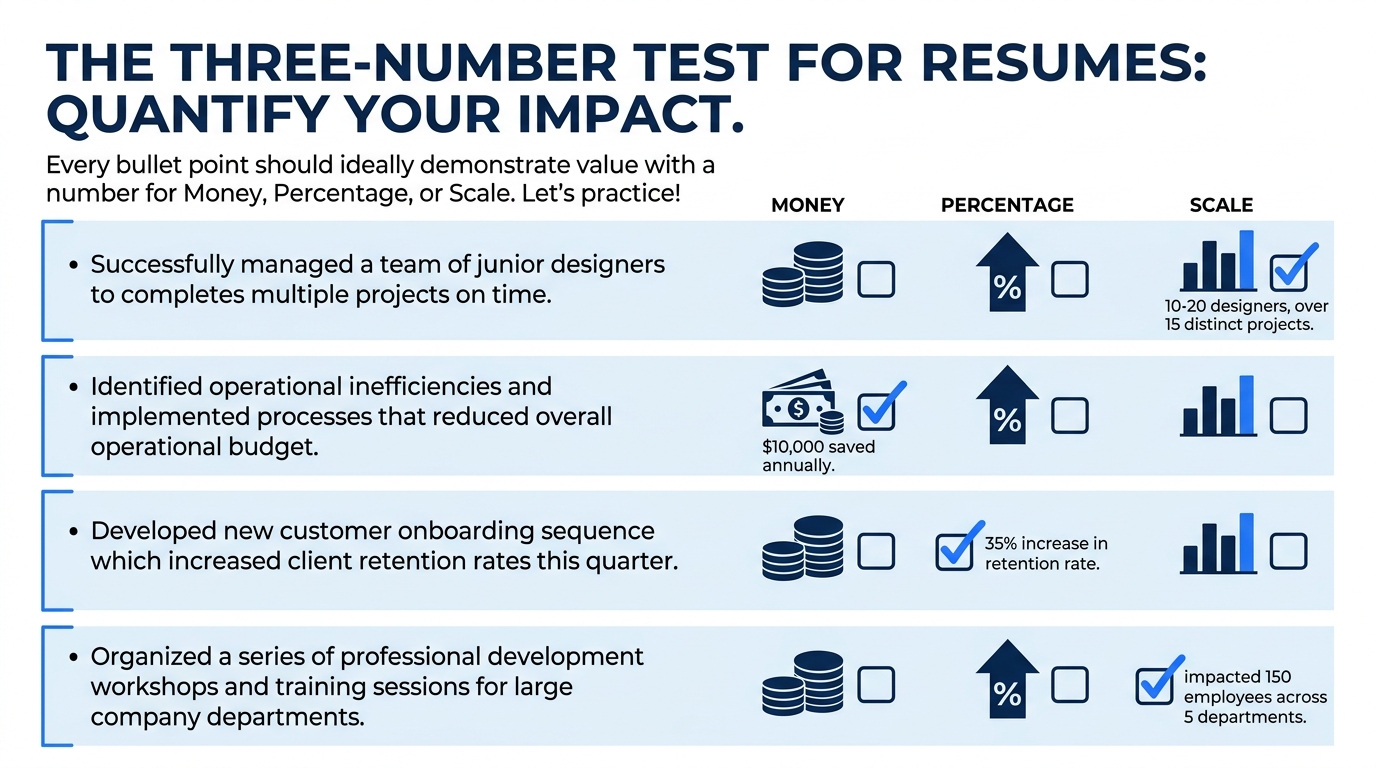
Here’s a framework worth applying to every line on your resume. I call it the Three-Number Test: each bullet should contain at least one of three types of measurable outcomes: money affected (dollars saved or revenue generated), percentage changed (efficiency, error rate, cost), or scale touched (people managed, units produced, systems implemented). Bullets that contain two of the three outperform bullets with one. Bullets with zero get skipped.
Look at how this plays out across real operations manager resume examples. Teal’s resume database includes a bullet where a candidate “analyzed production bottlenecks using Six Sigma methodologies, then executed targeted process improvements that elevated daily output from 1,200 to 1,750 units without additional headcount.” That single bullet hits all three numbers: 550 additional units per day (scale), a 45.8% output increase (percentage), and zero additional headcount (implicit cost savings).
Another example from Enhancv’s 2026 guide highlights an 18% increase in processing efficiency as a quantifiable achievement that lets recruiters “easily see the candidate’s value and impact.” And a ByRecruiters analysis cites “$200K per year” in reduced operational costs through “diligent expense analysis and implementation of process changes” as a benchmark bullet.
The Three-Number Test asks one question per bullet: does this line contain money affected, percentage changed, or scale touched? Two of three is strong. Zero of three means the bullet is dead weight.
The pattern holds across seniority levels. Even a bullet about onboarding new hires performs better with numbers attached: “Trained and onboarded 15+ new hires, 3 of whom went on to win Employee of the Month,” as cited by hCareers’ results-oriented resume guide. That’s scale (15 people), combined with a qualitative outcome (awards) that signals training quality.
If your bullets currently fail the Three-Number Test, run them through the process described in our guide on auditing your resume’s action verbs to tighten the language before adding metrics.
Tailored Applications Outperform Mass Blasts by 6x
The operations manager in this resume results case study didn’t send 100 identical applications. She sent 22 tailored ones over 10 days and landed 3 interviews, a 13.6% callback rate. That tracks closely with industry data: manually tailored resumes achieve a 12-18% callback rate from roughly 30-50 applications, while generic mass applications yield a 2-4% callback rate and require 80-120 sends to produce the same number of interviews.
Andy Hicks, SVP at staffing firm Top Stack, has emphasized that “being laid off doesn’t make you unemployable” and advises that networking, which fills 80% of jobs, paired with targeted applications produces results far faster than volume alone.
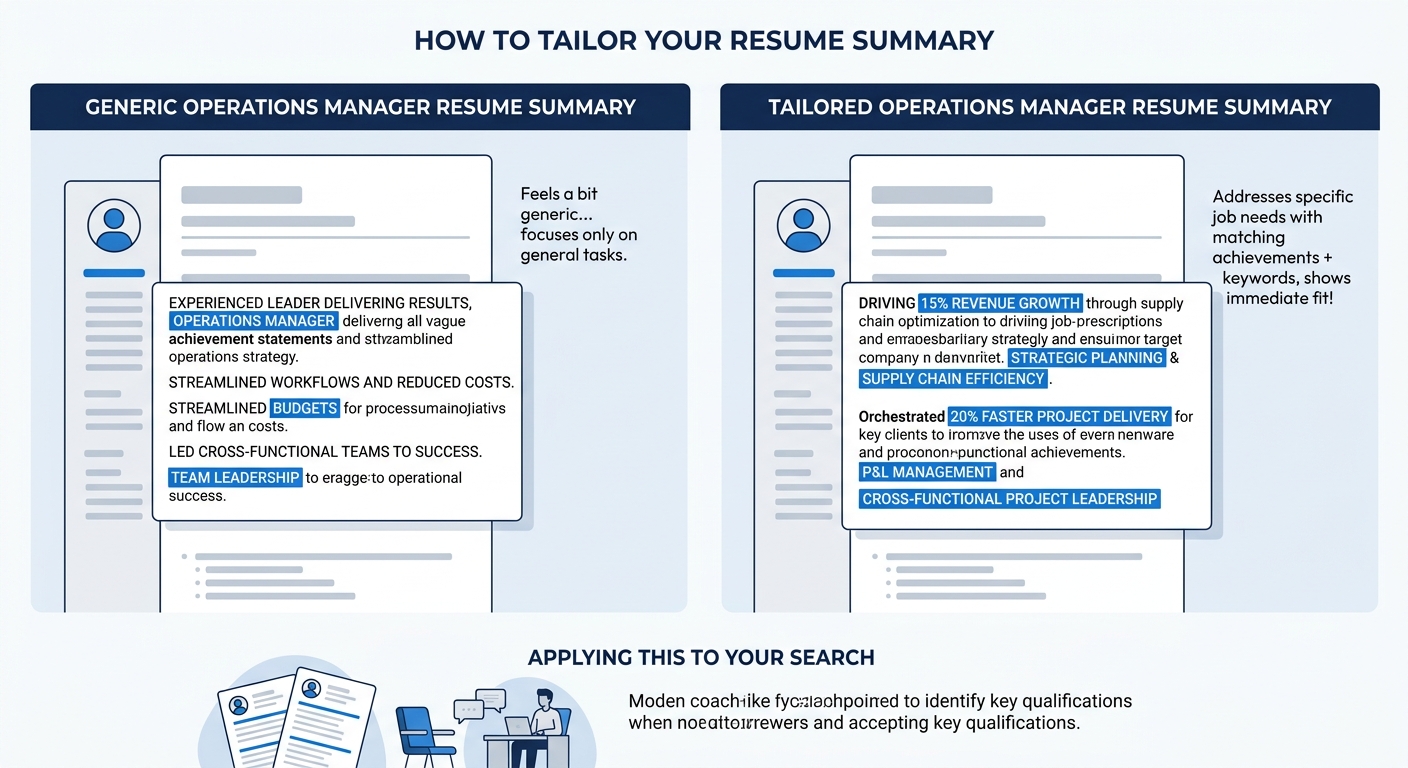
The tailoring itself doesn’t need to take hours. The core technique is reverse-engineering each job description into a weighted checklist, then rewriting your top 4-5 bullets to mirror the posting’s priority language. For an operations manager, if the posting emphasizes “cross-functional collaboration” and “vendor management,” those phrases belong in your bullets verbatim, wrapped around your outcome numbers.
Tip: Address a layoff directly on your resume with a brief parenthetical after the most recent role title: “Position eliminated in company-wide restructuring.” Research shows 58% of recruiters specifically look for employment gap explanations, and applicants who include one receive close to 60% more interview invitations than those who leave the gap unexplained.
Forbes contributor Caroline Castrillon wrote that a post-layoff resume summary “should tell the story of your transition: why you’re making this change, what transferable skills you bring, and what value you’ll create in your new field.” That advice holds whether you’re staying in operations or pivoting into a related function like supply chain strategy or program management.
And because 99% of organizations now use applicant tracking systems to screen resumes, your tailored bullets need to parse cleanly. If you’re unsure whether your format survives ATS screening, the World Economic Forum’s 2025 report noted that 44% of workers’ core skills will face disruption within five years, which means the keywords ATS systems prioritize are shifting too. Your post-layoff resume should reflect current job description language, not the internal jargon your former employer used.
For operations managers specifically, tools like Teal’s resume database show that KPI dashboards, process automation, and waste reduction are appearing with increasing frequency in 2026 postings. One example from their database cites a candidate who “collaborated with IT to develop customized KPI dashboards providing real-time visibility into operational metrics, enabling data-driven decision making that reduced waste by 17% and improved resource utilization.”
Browse more career guides on our blog for additional frameworks on writing targeted applications across industries.
Where This Leaves the Post-Layoff Resume
The thesis holds under scrutiny: the fastest way to convert a stalled post-layoff job search into active interviews is to rebuild every bullet around what changed, by how much, and over what timeframe. The operations manager in this case didn’t add new experience or earn a new certification during those 10 days. She rewrote 14 bullets using the Three-Number Test, added a one-line layoff explanation, tailored each application to its posting’s top 3 priorities, and sent 22 applications instead of 100.
Three interviews came back. A 13.6% callback rate from a resume that had previously generated zero responses over three weeks of mass applications.
The math on a process improvement resume is straightforward. Duty-based bullets describe a role you used to hold. Outcome-based bullets describe value you’re ready to create again. Hiring managers reading 200 applications per opening don’t have time to infer your impact from a list of responsibilities. They need the number, and they need it in the first 8 words of the bullet. Give them the $500K saved, the 15% efficiency gain, the 17% waste reduction, and you’ve made their decision easier. When you’re competing against candidates who are still writing “responsible for daily operations,” that difference is the entire gap between silence and a phone screen. The resume that wins is the one that answers the right question.